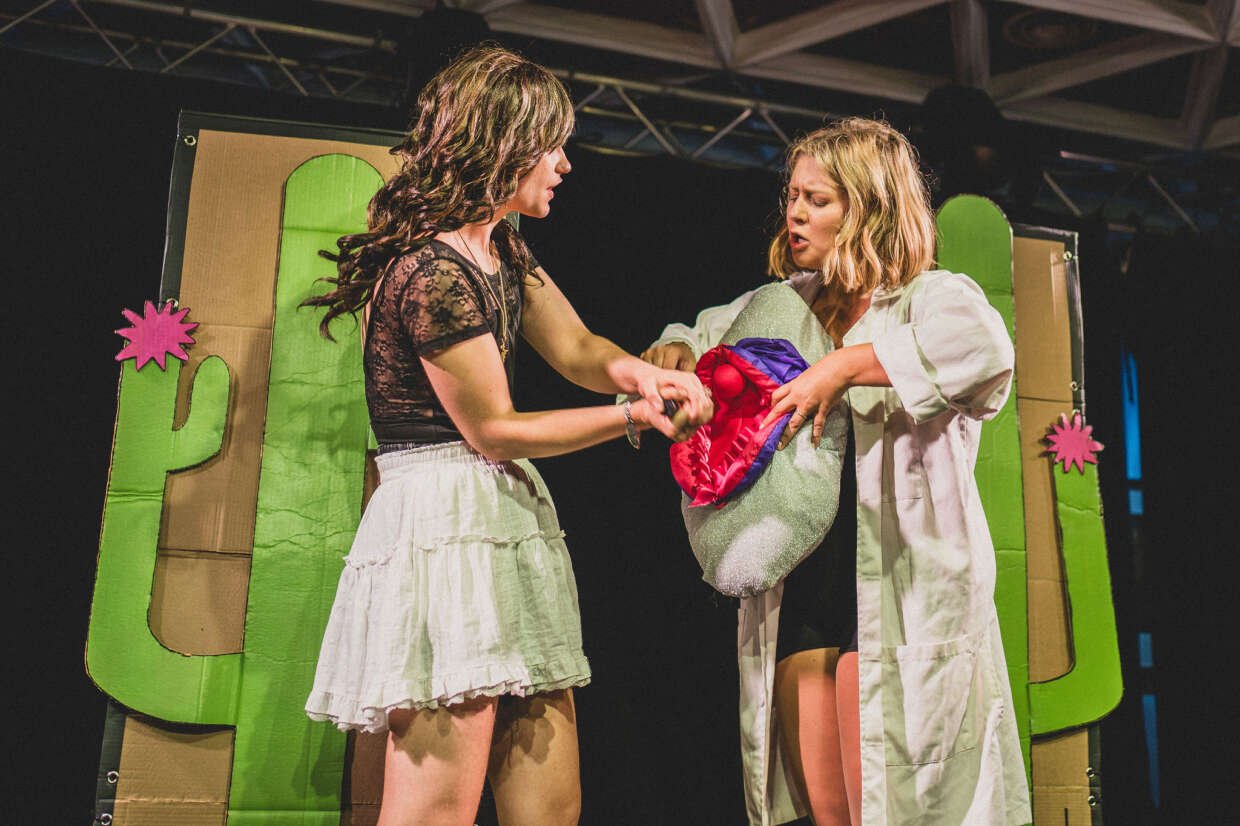
I met with Jenn Howd, a co-writer of the amazing show Texas Annie: The Legend of the Moan Ranger.
In an era of deepening censorship and growing threats to our personal freedoms, how far can art go to highlighting our plight?
I asked Jenn to tell me why they wrote Texas Annie and why it’s more important than ever.
Texas Annie: The Legend of the Moan Ranger is a campy pop-rock musical about a renegade sex toy dealer in Texas, where sex toys are declared illegal. It’s based on a real-life Obscene Devices law that was created in the ’70s, [in the US] stating that if you own six or more sex toys, it’s a felony. So you can legally own more guns, technically, in Texas than sex toys. The law was challenged federally, and it was overturned in 2008, Texas did not take it off the books.
My writing partner on the project, Roz Mihalko, and I actually wrote [Texas Annie the Moan Ranger] originally in 2011. We have some friends, John Woods and Cass King, who are a singing comedy duo in Canada named The Wet Spots, and they wrote the original song Texas Annie. We heard the song, about this renegade sex toy character. We asked John and Cass if we could have their permission to write a screenplay based on that character, and they said yes.
In 2011, the political climate was very different in the United States. Obama was in office and we thought, “Hey, here’s this silly law that we can kind of satire.” And honestly, we never in a million years thought that it would be relevant again.
When Trump got into office the first time in 2017, something kind of went off inside of me. It was like a little beacon. And I was like, “I have to make a music video for ‘Texas Annie,’ because I need to get the material out there.” So I took one of the songs from the piece and made a music video. I have a background in video and film, but it was a big undertaking for me, and I was scared shitless.
I did it anyway, and it turned out really, really great and I toured around in film festivals with it. At that time, things were not as bad politically, but still, things had taken a turn because it was Trump.
People were starting to be like, “Oh God, this could be relevant again,” but it didn’t really hit so hard at that time yet. And then just increasingly over the years, as the government has become more and more anti-LGBTQ, more fascist-leaning in their ways of censoring us, there has become a different urgency to get this project out that really didn’t exist when we first created it. I personally got involved with it, number one, because I thought it would be fun to write a campy satire about this law, but also because I grew up in a very conservative New England town in New Hampshire in the United States.
We never in a million years thought that it would be relevant again.
My parents were very conservative and kind of religious. I couldn’t even say the word “sex” in my house. I grew up with a lot of shame and fear around it, certainly not empowered in any way.
I had begun my journey of stepping into finding my power right before we started writing this, and I knew that jumping into it would help me kind of face a lot of my demons around it. And, you know, “Learn to love yourself,” one of the songs in the show, is literally about physically learning to love yourself, but also learning to love yourself, in general, in all the ways. And I was very much on that learning-to-love-myself journey in writing that song, and just found it incredibly healing to not only write the song…
[Jenn and I both tear up as they express how it felt to have the work resonate with people.]
… but to witness audiences really receiving the message with joy, and with other people together in a room, laughing. You know, the show really is about loving yourself in all the ways. And because it’s so funny, it really helps people take their guard down a little bit. And we have a lot of heart in the show too, so that also helps kind of balance everything and open folks up.
Over the years of doing this show and the different places that we’ve done it, I’ve heard over and over again, literally from people, “This show changed my life.” Which sounds like a silly thing to say about a campy dildo musical, but it really is touching people. And that makes all the tired that I feel right now really worth it.
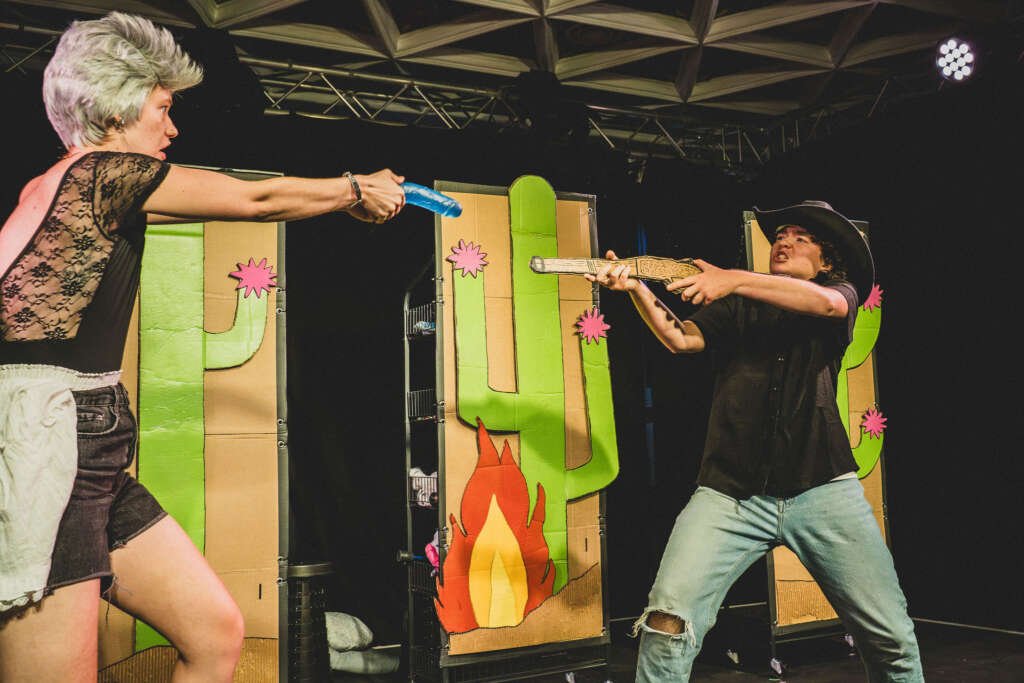
When you see the show, you can tell that whoever crafted this piece knows it’s important. And that makes it, and shows like it, an act of heroism if you ask me. It costs a lot of time and money and there’s probably very little thanks on a day-to-day basis. When creators keep on pushing through despite the obstacles coming at them it’s the most incredible thing. One of the questions I’ve had burning since I sat down to watch the show is whether they’ve taken the show to Texas.
Jenn explains that while they’ve done shows in Cincinnati, New York and now Edinburgh, they haven’t toured Texas… yet. After talking about determination and funding one’s art habit, Jenn told me they’re on the autistic spectrum and was awarded a grant from the Autistic Theatremakers Alliance based in New York to show there. That opportunity also helped bring the show to Edinburgh.
Texas Annie was included in a showcase at Joe’s Pub in NYC where Jenn met a producer from Texas. She really connected with the material, and told Jenn, “I think there are some theatres in Texas that would really be interested in putting on this show.”
Jenn adds, “I don’t know that I could feel completely complete without the show having been produced in Texas.”
Since being diagnosed with autism and their own journey with loving themselves, Jenn has embraced sex positivity.
I hang out within sex positive community, whatever form that takes, I’m all in. My autism shows up in a lot of different ways, but one of them is for sure, not giving a shit about silly things that other people think are important.
And I wasn’t able to express that until I went through the process of healing the shame. And now that I feel like that has been mostly healed, I have zero challenges with just saying what I think about the subject.
I’m happy to confront folks as easily and as kindly as I can with societal norms that don’t actually help us. And shame around sex and not talking about it is one of those societal norms that is really harmful.
And I wholeheartedly agree. Moving on to some lighter topics I ask Jenn who their favourite Texas Annie character is. And I’m delighted when they immediately mention Rainbow, an astral planing sex educator whose spirit inhabits a Fleshlight masturbator.
Rainbow Fleshlight is just such a delight. She was modelled after Lily Tomlin in Grace and Frankie. When Roz and I saw that show, we were like, “Oh, yeah, Lily Tomlin would be perfect to play.” Because we were thinking about it as a movie, we were looking at movie stars. But, yeah, Rainbow is just a delight in every way. And, in fact, there’s a song that Rainbow sings that we had to cut out of the Edinburgh fringe because we didn’t have enough time for it. But it’s on our concept album on Spotify, and it’s called “Swallow Your Destiny.” And it’s definitely not about blowjobs. It’s a Mary Poppins send-off too, so the music is very Mary Poppins. It’s very, very funny.
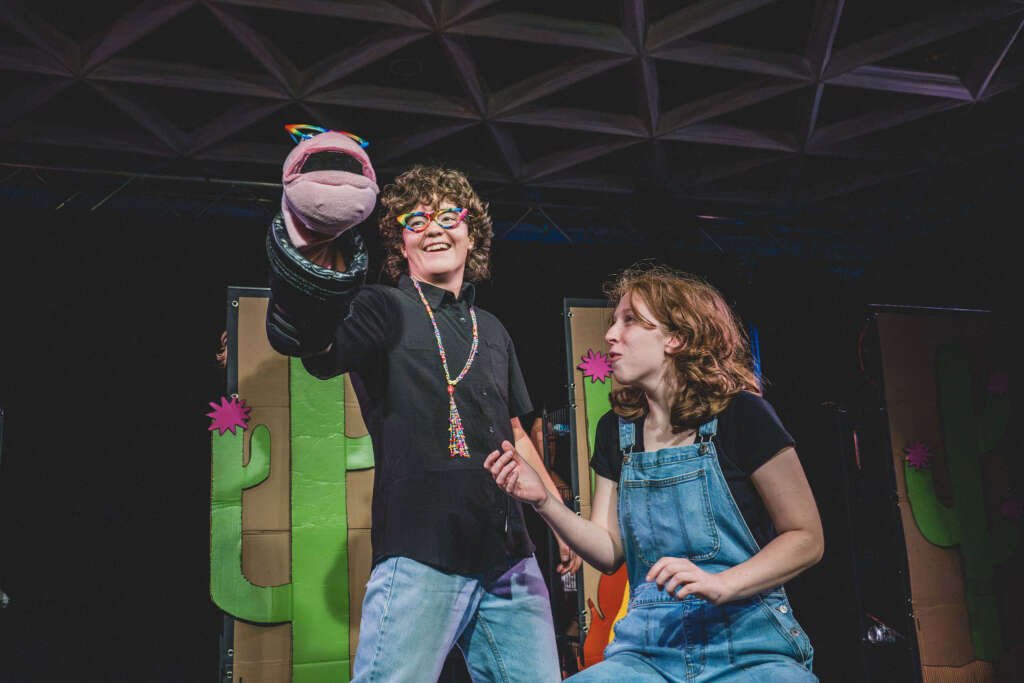
While Jenn hasn’t approached Fleshlight directly for sponsorship (they absolutely should imo) the first ten audience members do receive a mini vibe from CalExotics to remember the show fondly afterwards…
Texas Annie ran for nine days at the Fringe but due to its phenomenal popularity, I asked what’s next for the show.
What’s clear to me is that the show is viable. With the amount of sellouts that we had, with literally only five seats [empty] for our entire run, that tells me that people like the show. And that an audience will show up for it. So, armed with that information and data, I will be probably looking for a producer who can come on to inject the project with some funds that will help it move to the next level. Whether that’s having a little bit of an actual budget to come back to Edinburgh, have a bigger stage, more resources, or do a longer run. So perhaps starting to investigate other possibilities for a tour, and potentially heading back to New York City where we did “The Fringe” before, doing just a separate run for us at some point there. We do have a lot of people in Cincinnati who didn’t get a chance to see it, who’ve known the show has gone on to do really well, so maybe we’ll bring it back to Cincinnati too. But someday, hopefully—it’ll be made into a film, like the original script. I would love for it to be on HBO or Netflix or something like that.
Jenn will also be going back to their other career in “weird experimental music and sound art” with an installation at the Cincinnati Art Museum alongside other musicians.
Roz, Jenn’s writing partner, has a sex-positive show called “1-800-SEX-WYZE: The Health Hotline Musical” which she wrote with John Woods of The Wet Spots, who also worked on the music for Texas Annie. Roz’s show was performed in the Vancouver Fringe Festival.
If you’re into weird experimental and ambient music, you can find me at Jen Howd on my Instagram. You can also reach out to me on the Instagram for Texas Annie, if you’re interested in discussing ways that we could potentially help each other out. I would love to partner with sex educators for this show.
All images by Berenika Murray