

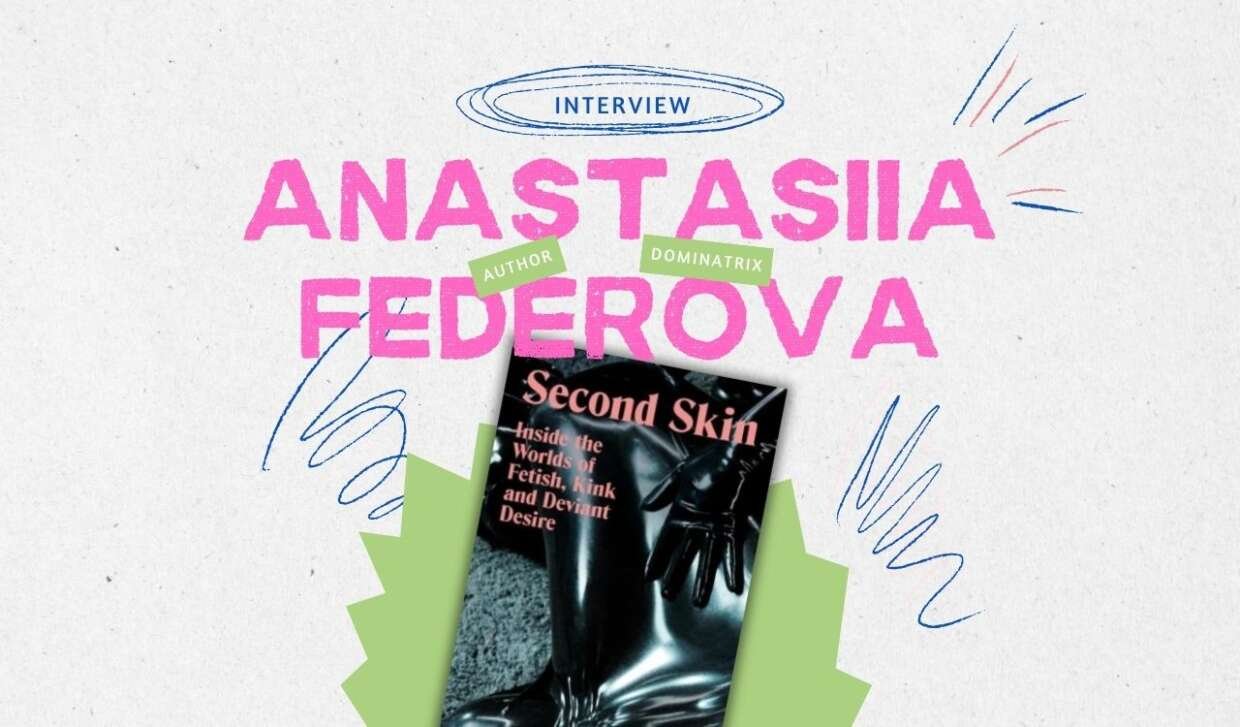
This interview marks Lewis’ debut writing for Pillow Talk. They have been an avid attendee (and occasional host!) of the Sex Positive Book Club. When organising last month’s book club, they suggested Second Skin by Anastasiia Fedorova. Then, they reached out to her and had the pleasure of going underneath the “second skin” in conversation.
The book offers an in-depth look into the world of kink, fetish and deviant desire, tracing the history and the communities where these things thrive today. It contains many interviews with people in these communities and is backed up by research done at the London Fetish Archive, amongst other sources.
Let’s dive in.
There was a brilliant quote from the latex chapter where you said, “I sincerely hope that you feel repulsed at least once or twice while reading this book, and you can tap into that uncomfortable feeling”.
Did you run into any challenges when you were writing this book, or did you ever feel like you were crossing that line, maybe, where it was becoming too uncomfortable?
I think that discomfort — and just being around taboos, cultural preconceptions, maybe internal boundaries, and shame, of course — is such a key part of anyone whose sexuality relates to BDSM, kink, and anything which is connected to taboos. It’s just a big part of how we explore, and it’s always been really important to me because I think, to have an informed, inspiring, and creative conversation about a topic like kink, you have to acknowledge that it is not for everyone.
Its proximity to taboo and darkness is actually one of the most beautiful things about it, and this is why it draws people to it. While there are a lot of discourses around sex and a lot of them overlap with wellness, and having good sex is good for you, kink is different is to me because there’s so much of that darkness and creativity and just things which are on the fringe of your own understanding of self and comfort, which make it such a great topic to write about.
Do you think that the digital age is something that’s helping the conservation and the conversation around kink? Or do you think it’s something it’s harming them, as is the case for restricted films like Blood Milk?
It’s a very interesting and a very difficult question, because our experience of sexuality on the internet is very connected to social media censorship, which has pretty much warped what we see as acceptable and possible online and what we even get to become. It even changes our understanding of what is obscene and what is not, even beyond the internet.
A good example outside of kink is like how Instagram deletes anything which has nipples in it, and it has for a long time. I feel that, because of that, there are certain photographs which are not being taken, there are certain paintings which are not being created, there’s certain visual art and visual expression which is just not there for people, especially younger people. That is really sad.
You have such a visual way of describing kink and fetish and creating that imagery. Do you think that your perception and your view of kink and how that resonates with you have been directly impacted by your kind of journalistic experience, looking at fashion and art in culture writing?
I think it was definitely something which was crucial because I really wanted to combine my experience as a culture writer with my experience as someone who is part of the kink community, because that really helped me to approach the paradox of how kink culture fetish aesthetic are so visible but yet they are not very understood to their full like depth and complexity.
It was quite useful that I had an experience in cultural criticism, so I could hold up these topics in the same way I had written about art or fashion and look at them as parts of culture, but also personal experiences could contribute to a more embodied presence.
But yeah, I’ve always been interested in commodity culture and what happens, you know, how we desire things and objects, how we shop, how we want to transform ourselves with what we own and what we wear. Especially working in fashion, which I’ve done for like quite a while at the beginning of my career.
Ot always mesmerised me that idea of how we prescribe so much beauty and power to garments and shoes and everything. When I started talking to fetishists, I was like, “Oh, it’s essentially kind of the same thing, but from different angles.”
The way that you described your first pair of latex gloves was absolutely intoxicating. I got the feeling, you know, I got the emotion of unboxing that, and I wanted to ask you: do you still have those latex gloves?
One of them ripped, of course, because they always rip.
They were Lady Lucy gloves, which are a bit more expensive than other types of gloves, but they were pretty good. They were a little bit on the bigger side, so they were giving, as somebody told me, “dishwasher glove” vibes, which I actually didn’t mind. I quite like that. It’s giving you ready for the dirty work.
Listen, we all we all like a French maid, but where’s a house cleaner from Scunthorpe? That’s what I know. Let’s wake that up.
In another interview with Be serious!, you said you could have written another 40 chapters to go into this book. Are there any that almost made the cut that you had to leave out? Does this leave the door open for book number two?
Well, I hope so! I really wish I had more time to separate the feet chapter from the footwear and write a comprehensive chapter on high heels, boots, and trainers separately, because there’s a lot there which could be unpacked. Again, all of them could be their own chapters because there’s so much aesthetically and culturally in terms of different codes and practices people engage in. It would be so good to write about that.
Nylon is another one. It was after I had written the book, actually, that I started realising that’s something I could have definitely looked at. But it was not in the original proposal and it slipped off my radar. I’m really interested in nylon, though; how it works, what different cultures exist in different countries, think of the full body nylon suits and how they overlap with the Japanese culture of Zentai suits and all that community.
So, that would be definitely interesting and also the whole thing with inflatable things like big inflatables.
Here’s my final question for you… We run a Sex Positive Book Club in Glasgow, and we’re always looking for recommendations. Anastasiia, what would your book recommendations be for us?
I have talked about Gay Bar: Why We Went Out by Jeremy Afredin-Lins a few times because it really inspired me when I was working on my book proposal, and it just inspired me as a piece of non-fiction.
It changed my idea of what non-fiction could be, how sex could be part of it, and how you could write about sex in a non-fiction book because it talks about it, has a lot of historical research, but it talks about gay bars without sanitising them.
Help us make room for pleasure
Pillow Talk Scotland is powered by our community, not by advertisers or big corporations. Your support helps us keep our work independent, run community events, and create inclusive, pleasure-centred resources for people across Scotland and beyond.
If you’ve found this piece useful, please consider supporting our work.
→ Chip in once – whatever you can
→ Become a monthly supporter – help us plan ahead and make more room for pleasure, together.
*This interview has been edited for length and clarity.