

Self-care note: This wrap-up includes discussion of HIV, child trafficking, anti-LGBTQIA+ policies and behaviours, gender based violence, and more. If you find this distressing or triggering, remember to take it at your own pace. You may prefer to read small sections, wait until you feel ready to read it all, or choose not to read it at all.
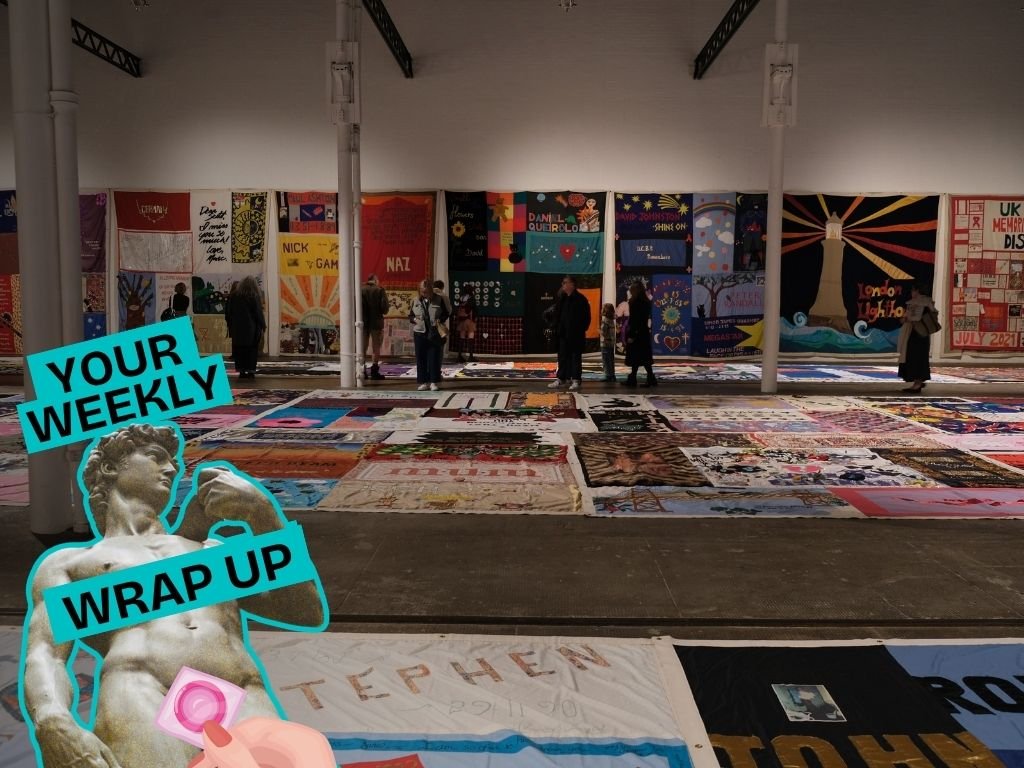
1. UK AIDS Memorial Quilt shown in full in Scotland for the first time 🧵
The UK AIDS Memorial Quilt is being displayed in full in Scotland for the first time, with all 335 panels brought together at Tramway in Glasgow.
The Quilt commemorates more than 600 people who died during the HIV and AIDS crisis in the UK. The exhibition also includes archival material exploring the project’s Scottish roots and the documentary There Is A Light That Never Goes Out.
A programme of events will run alongside the free exhibition, including talks, performances, screenings, archiving sessions, an ACT UP activist day and textile workshops exploring memory and patch-making.
Source: Glasgow Life
2. Glasgow anti-immigration group criticised over support for Andrew Tate ⚠️
The Pink Ladies, an anti-immigration group which held a protest in Glasgow yesterday, has been criticised after its Glasgow branch shared material from Andrew and Tristan Tate on social media.
Campaigners including Stand Up to Racism and Women Against the Far Right accused the group of hypocrisy, arguing that support for figures associated with misogynistic online movements undermines its stated aim of protecting women and girls. Andrew and Tristan Tate are facing serious criminal allegations, which they deny.
The Pink Ladies has denied weaponising violence against women and said its Glasgow branch is independent of other groups involved in promoting the rally.
Source: Glasgow Live
3. Vietnamese children trafficked to Scotland for sexual and labour exploitation 🚨
Hundreds of cases involving Vietnamese and other south-east Asian children potentially trafficked into Scotland have been referred to Police Scotland since 2020, with some children reportedly sexually exploited or forced to work.
Figures obtained through a freedom of information request show 342 referrals involving children kept in conditions of slavery, including 31 cases linked to sexual exploitation. Glasgow accounted for 72 referrals, while Edinburgh had 74 and Ayrshire 49.
Experts and anti-trafficking charities say children can be forced into cannabis farms, nail bars, car washes, hospitality, domestic servitude and sexual exploitation, often by organised crime groups. Campaigners have warned that the true scale may be much larger and called for stronger protection, specialist support and better data on child exploitation in Scotland.
Source: Glasgow Live
4. Twice-yearly injectable PrEP rejected by NICE over cost 💉
NICE has recommended against making lenacapavir, a twice-yearly injectable form of HIV pre-exposure prophylaxis (PrEP), available on the NHS in England and Wales.
In draft guidance, NICE said the drug was not cost effective at the price proposed by manufacturer Gilead. Its analysis put the cost above NICE’s £35,000 per quality-adjusted life year threshold. The proposed UK price has not been disclosed, although Gilead announced a US list price of $28,218 per person per year last year.
HIV organisations including Terrence Higgins Trust have criticised the decision, arguing that injectable PrEP could expand access for people who struggle to take daily tablets or regularly attend sexual health services. They are calling on NICE, NHS England and Gilead to reopen negotiations, with campaigners urging Gilead to reduce the price so the treatment can be made available.
Source: The BMJ / Terrence Higgins Trust
5. Bonnie Blue reported over safeguarding concerns following birth of baby 👶
Adult content creator Bonnie Blue has been reported to the NSPCC by Conservative equalities spokesperson Joy Morrissey over concerns about content posted following the birth of her baby.
Morrissey raised concerns about a video in which Blue appears to hold a heavily pixelated newborn while surrounded by men in balaclavas, alongside references to her adult-content persona. In the same video, Blue claimed that the “six-week rule” for having sex after childbirth did not apply to her because she had given birth by C-section.
Blue has rejected the criticism, saying her baby is “loved, protected and incredibly well looked after” and that she maintains a boundary between her work and being a parent.
Editor’s note: There is no universal NHS rule requiring everyone to wait six weeks before having sex after giving birth. However, having a C-section does not remove the need for postpartum recovery. NHS guidance says people can resume sex when they feel ready, while its specific guidance on recovering from a C-section says activities including sex may not be comfortable for “6 weeks or so”. A C-section also involves internal healing, and recovery varies from person to person.
6. Grindr agrees £26m settlement over claims it shared users’ HIV status 🔐
Grindr has agreed to pay £26 million to settle a UK lawsuit brought by 12,000 users who alleged that the dating app shared highly sensitive personal information, including in some cases their HIV status, with advertising companies.
The case, filed in 2024, concerned data practices before 2020 and alleged breaches of UK privacy law. Grindr has not admitted liability, but said it recognised the distress and loss of trust expressed by some users.
The company previously faced scrutiny over its handling of personal data, including a fine from Norway’s data protection authority. Grindr says it has since overhauled its privacy programme and strengthened user controls.
Source: The Guardian
7. Ectopic pregnancy deaths rise sharply in the US, especially in abortion-ban states ⚠️
Deaths involving ectopic pregnancy in the United States have nearly doubled in recent years, according to a ProPublica analysis of CDC data.
Almost 200 women died following an ectopic pregnancy between 2020 and 2025, compared with around 100 in the previous six years. The increase happened nationwide, but ProPublica found the rise was steeper in states with strict abortion bans.
Ectopic pregnancies are not viable and can become life-threatening if they rupture.
Although abortion bans generally include exceptions for ectopic pregnancy, doctors and patients have reported delays in treatment where clinicians are uncertain whether they can legally intervene before the diagnosis is definitive. Experts caution that abortion restrictions are unlikely to be the only factor behind the rise, but say their impact on delays in care should be investigated.
Source: ProPublica
8. New $15.5m fund launched to accelerate efforts to end FGM worldwide ✊
A new $15.5 million (£11.4 million) fund has been launched to support efforts to end female genital mutilation (FGM), which has affected more than 230 million women and girls worldwide.
The Her Horizon Fund, created by the US-based Wallace Global Fund, aims to raise $100 million in total and direct more funding towards survivor-led and frontline organisations working in communities where FGM remains prevalent. The launch comes as international funding for this work is falling, with the main UN programme to end FGM seeing its funding drop by 45 per cent last year.
Campaigners say progress remains fragile despite decades of work, with legal protections facing challenges in some countries and frontline groups struggling for resources. The UN has a target of ending FGM by 2030, but current progress is not on track to meet it.
Source: The Guardian