


The Fringe is always awash in shows where performers get naked. Many performers opt to plumb the depths of their own experiences in order to make work that is authentic, and this can mean a show hits harder for the audience, or the performer themselves may be subject to increased scrutiny in the press.
But often what these shows are truly seeking to create is a sense of affinity and connection. To do this by making your own body into a stage, to be vulnerable with strangers in this way is truly a gift.
Stacey Clare’s Ask A Stripper, is now something of an Edinburgh institution. Clare, author of The Ethical Stripper, is now in her eighth year of making theatre out of her own and her colleagues’ experiences navigating the nighttime economy, and the legal status of various forms of sex work.
With its rotating series of guests and the unpredictability of audience questions, Ask A Stripper is never dull.
Drawing on her her wealth of experience in dealing with profound ignorance and prurient curiosity, Clare’s show is always an education in why you should continually re-evaluate your understanding of consent. Clare always reminds her audience that they’re not allowed to touch her or her guest, even when someone is getting a lap dance; this is a stark reminder that sex workers are still continually stigmatised by the misguided belief that because they have placed their body in the marketplace, they are unworthy of boundaries or respect.
Ask A Stripper asks us to accept nudity as a state of the body that can be erotic, but also entirely neutral.
Seated on her ‘stripper towel’ she and her guest spend the majority of the show completely naked except for their shoes as they field audience questions about income, clients, strip club owners, and (inevitably) what they enjoy about their work. The answer to ‘what do you enjoy?’ is usually ‘the money’ or for some, the time that is freed up for other pursuits.
The night I saw the show, Stacey’s guest was the incomparable Keri Gold, a stripper and choreographer who now travels the world on cruise ships performing burlesque and kink-themed shows.
At 56, Keri is a model to us all: a radiant, joyful being, with a fascinating career who loves what she does. While Gold has been subject to the highs and lows of strip club work, she has nonetheless made a life in performance, long past the age when many dancers (of whatever style) have retired from performing live. When I look at Keri Gold (if Instagram lets you view her restricted profile), I see someone who has defied the cultural belief that, (particularly when you are engaged in erotic performance,) “women age like bread, not wine” (see Ti West’s Maxxxine (2024) for this immortal line).
Ask A Stripper is a show that destigmatises sex workers by humanising them before a different audience every night, and it asks us to accept nudity as a state of the body that can be erotic, but also entirely neutral.

Sadiq Ali’s show Tell Me, also deals with stigma. Made in part with funding from Waverley Care, Tell Me uses dance and circus to tell a story of three different characters who receive an HIV diagnosis.
Intended as a historic piece, there are voiceovers and music that place us in the 1980s. Helmed by Sadiq, an Edinburgh-born performer who is both queer and HIV-positive himself, he is accompanied by two other incredible dancers.
All three performers undertake breathtaking pole work, often combined with feats of balance, strength and grace on and around spinning, metal cubes. These cubes in turn become nightclubs, hospital rooms, and even tender nests for spooning lovers.
What emerges here is the vital importance of community as a place of support and the nightclub as a site of both queer joy and dissociation. The sense of joy and belonging is never more evident than when all three performers are sweaty and topless at the disco, a decision that refuses the unnecessary modesty imposed on performers with breasts. This sense of egalitarian toplessness is part of what makes the queer space welcoming (as any regulars of Hot Mess at the Poetry Club or Sneaky Pete’s will tell you).
But Tell Me is not here to suggest that nightlife can solve our problems, and at another juncture, a smoke-filled cube is a terrifying labyrinth, a place without solace. Tell Me is a show that suggests through its every movement that what we all want is to feel held and understood, rather than judged for our sexuality or our lifestyle.
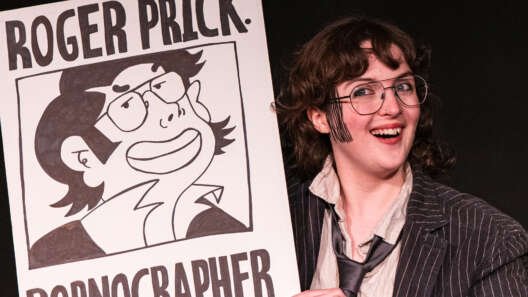
This brings me to Mother, Maiden, and Crone (MMC). Billed as an irreverent re-telling of Macbeth from the witches’ perspective (if the witches were the jaded employees of Edinburgh’s gay bars), MMC is much more than this.
Wearing its Shakespeare lightly, MMC encompasses the internecine drama of a central belt hen night, self-hating queers, the importance of preserving queer spaces, and why it’s never okay to grope your server.
The entire cast absolutely eats in this, crammed with wit, memorable catch-phrases, astonishing prat falls from Gazelle (Alicia Tryde,) scintillating Lady Gaga choreo led by Brandi (Zara Kennedy), and a healing use of the make-over.
All of these shows seek to undo or expose stigma in some way, and they do so in a variety of formats.
What has stayed with me from this irreverent romp of a show is one of its moments of sincerity: the intervention that takes place between token hen-night gay bestie Layton (Kennedy Thomson) and Maiden (Ewan Burns). Maiden calls out Layton for his use of self-referential homophobic slurs, identifying this practice as a brandishing of Layton’s self-hatred and insecurity. Maiden (as one might expect from a character so-named) revels in their femininity, sporting an array of outfits chosen primarily for how well they make an impression rather than how they might fit with binary notions of gender. But, beneath Maiden’s elegance lurks razor-sharp perception, which is here deployed to ‘read’ Layton in every sense. Layton confesses his deep sense of shame, and acknowledges the ways in which the performance of sexual identity can still be constrained by place, community, and social expectations.
All of these shows seek to undo or expose stigma in some way, and they do so in a variety of formats, which in turn tells us about the urgency of the work to tackle stigma as it relates to matters of sexuality and bodily autonomy.