


This piece was edited on September 3 to correct a misinterpretation on our part. The protagonist of this play sleeps with men on Grindr but does not kill them. Instead, he hunts all cis men that he deems to be bad people.
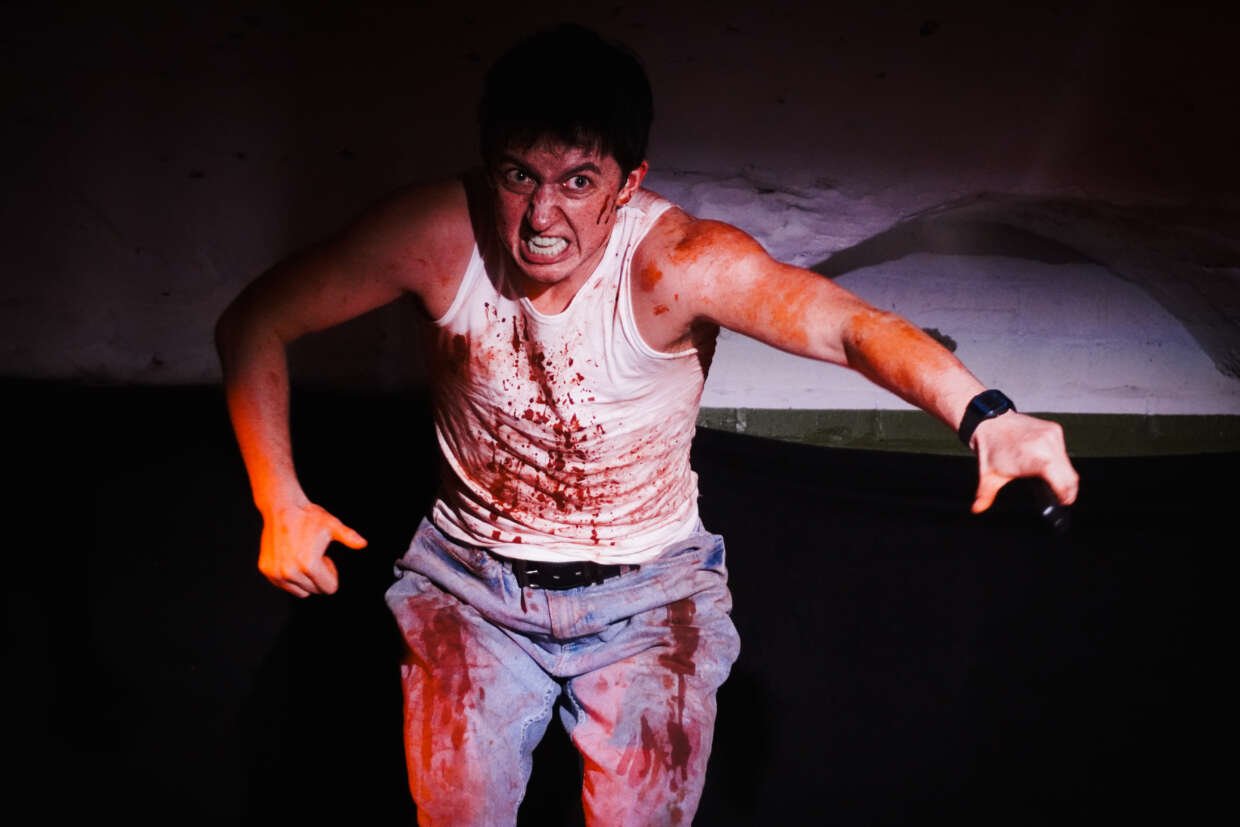
A significant aspect of the long-standing filmic tradition of the charismatic psychokiller (from Dexter and Patrick Bateman to Hannibal Lecter) is that such narratives tend to give their audience a good reason to root for their monsters. Sometimes it is a moral code; sometimes sheer charisma; sometimes an attraction to refinement, intelligence, or the perversely compelling logic of a criminal mind. In the Fringe play Trans People Are Awful, most of these mechanisms are arguably at work in its main character: a murderous trans man who hunts cis men in pursuit of perfect body parts to self-transplant. Brilliantly played by Ros Watt, he is both a child of this cultural tradition and an entirely new breed of killer, leaning into uncharted territory to give us a criminal who is at once magnificently camp and unexpectedly tragic.
He has more than good enough reason for his rage: he is killing to obtain the body he so desperately wants and has been denied.
First, there is something distinctly John Waters about the way Watt makes monstrosity irresistible, much like Divine at her best. Think Dawn Davenport in Female Trouble, who turns criminality into a career in notoriety. She wants fame through filth, crime and perversion (and Waters films her ambition with equal perversity and admiration. She’s horrible, she knows it, and she absolutely loves herself for it — and the audience loves her even more. Watt’s killer, as peculiarly passionate about his craft as Dawn, possesses that same intoxicating energy.
And not just that. He is gloriously unhinged yet refined in his craft. Sweetly, he is both perverse and innocent — a contradiction made wonderfully clear when he tells us about his modus operandi with extreme detachment, and, in the same breath and with exactly the same matter-of-factness, confides that he has never so much as kissed a man before. It is in such a way that he pulls us — senses, emotions, and laughs deep — into his murderous crimes.
He also skillfully provides us with a twisted yet easily agreeable moral code to lean on. Refreshingly, his inner struggle is not built from the usual catalogue of traumas that explains the genre’s psychopaths. In fact, his monstrosity is not presented as an inherent consequence of his identity at all — though never made explicit, it is suggested to be something far more entangled with the violence of the world around him. By this I mean the easily recognisable social expectations, humiliations, and exclusions tied to queer experience (and more particularly to transness) that seem always to lurk in the dark space offstage (that part of the character’s life we do not see), and that can make inhabiting one’s own body and identity, and, moreover, one’s very life, a pathologizing struggle.
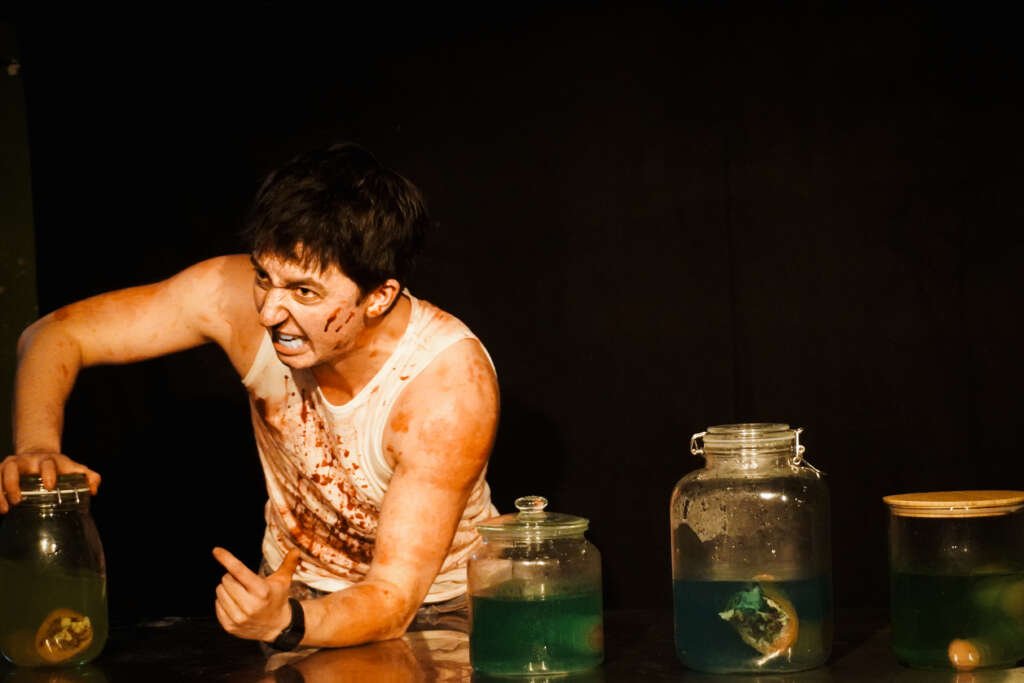
It becomes no stretch, then, for the play to invite us to revel in this trans man’s perverse, very specific, and (brilliantly) awful attitude toward cis men. And he has more than good enough reason for his rage: he is killing to obtain the body he so desperately wants and has been denied.
All of these various narrative and performative aspects work perfectly together toward building audience identification with, and intoxication by, the excesses of this refreshingly awful queer character. The real punch of the play, however, is that while it does all this work to make us enjoy Watt’s awfulness and insanity, to participate in it, and, in true John Waters fashion, to believe that we are safe inside the darkly perverted satirical territory into which the play has immersed us, it suddenly takes us somewhere else: a final realistic, tragic turn – one that is particularly effective because it is so unexpected.
At the heart of the tragedy is something more devastating than most miserabilist Scottish dramatists or screenwriters could ever come up with; an event that comes with a myriad of ironically bleak and violent layers (which will not be delved into for the sake of spoilers).
What I will focus on instead is that, by bringing together horrendous tragedy and unhinged camp comedy, Trans People Are Awful manages to hold two seemingly contradictory impulses in tension without allowing either to cancel the other out. The camp makes the tragedy more shocking, while the tragedy retroactively complicates the camp.
In that sense, this brilliant new play feels almost like a John Waters film that has suddenly decided to let its joke hurt: it takes the same pleasure in excess, abjection, and outrageousness; it invites us to revel in its protagonist’s awfulness; and then it refuses to leave us safely inside the joke. Through that refusal, it constructs a play that, as its sold-out run demonstrates, is both enormously attractive and so, so very difficult to shake off.