






The body swap is one of comedy’s oldest tricks – and has long been used for various purposes. The multiple film adaptations of the famous novels Vice Versa (1882) and Freaky Friday (1972) use swaps between parents and children to pose generational and familial questions. Other films use them to explore differences of race or class and, finally, the classic romantic-comedy take on the trope asks what it might be like to experience the world as a different gender. In the Hayes Code-era film Turnabout (1940), a bickering married couple wake up in each other’s bodies and have to experience each other’s unfamiliar struggles. The Australian film Dating the Enemy (1996) follows much the same formula.
You wake up in an entirely different body, and somehow the biggest problem is mostly that you now have to deal with other people.
What all these films have in common, beyond their obvious concern with social differences and perspectives is, curiously, how little attention they pay to the bodies themselves. Once the swap happens, the body becomes almost entirely a vehicle for social experience: the joke is in being perceived as the other person and, in romantic comedy specifically, navigating their relationships and discovering that (cis) men and (cis) women experience the world very differently. (What a surprise, really.) But the physical reality of inhabiting a radically different body is barely interrogated – it is as if the body exists only in relation to the outside world, while its inner, physical life counts for almost nothing. The closest the genre comes to making the body itself consequential is, perhaps, in Dating the Enemy, when the newly body-swapped cis man gets his partner’s period. Even there, however, the transition remains bizarrely seamless: you wake up in an entirely different body, and somehow the biggest problem is mostly that you now have to deal with other people.
The play boobytrapped, written by Freddie Haberfellner and performed at this year’s Edinburgh Fringe, is based on this same, by now overused, body-swap formula. But it takes it somewhere so unexpectedly apt that it leaves you wondering why it has not been done before. By swapping the bodies of a gay cis man (Kevin) and a trans man (Simon), it retains the romcom’s traditional interest in negotiating contemporary norms and mores (in this case, around masculinity and gay sexuality) while also turning the focus inward, to ask what it actually feels like to inhabit a physical body from which you feel estranged.
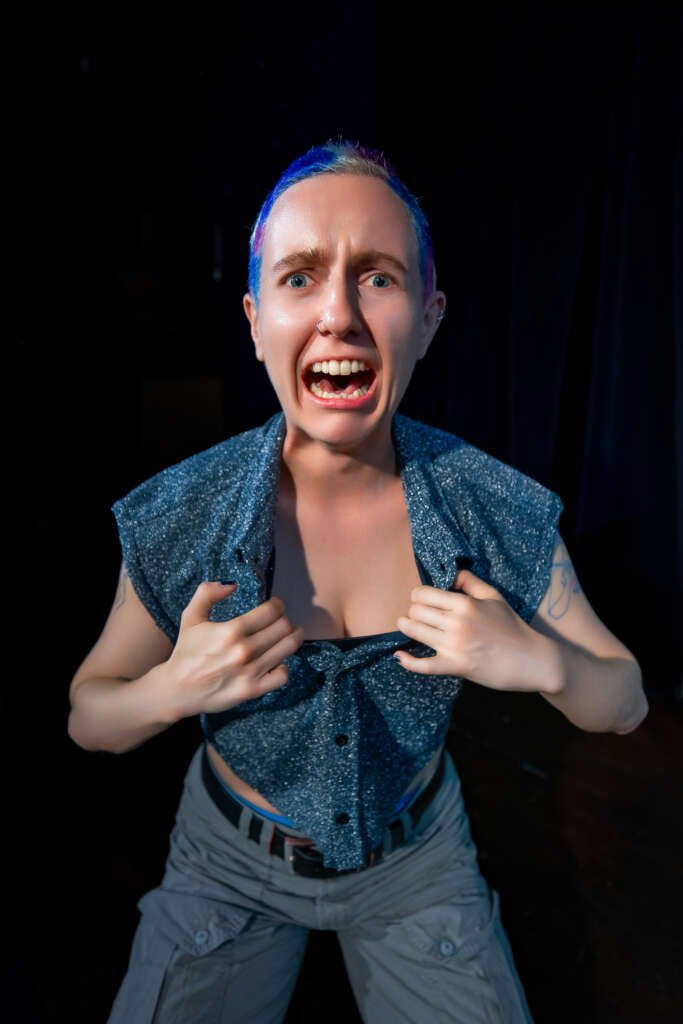
And this is where some of its most affecting scenes emerge. In the immediate aftermath of the swap, we watch Simon, the trans man now inside a cis man’s body, joyfully eager to explore his new physical self, while Kevin, now in Simon’s body, initially struggles to breathe because of the presence of a binder. Eventually, with Simon’s help, he removes it and is confronted with the sight of breasts.
At first, the sight prompts a reaction we know well from body-swap films: the cis man joyfully admiring his newly acquired breasts. But then the familiar joke turns sour: Kevin realises that the breasts are not going anywhere – that a body part that feels entirely alien to him cannot simply be taken off – and his delight gives way to utter despair. It is a small but remarkably effective reversal of the body-swap gag: what is usually a moment of playful curiosity becomes an encounter with the terrifying reality of being stuck in a body that does not feel like yours.
The ideas in play are not abstract thoughts on masculinity or sexual preferences: they concern the two bodies, and two sets of desires presently locked in an unavoidable conflict.
Similarly interesting is the fact that the play’s limited interest in the outside world (perhaps partly a consequence of its short running time) makes for an increasingly claustrophobic encounter, in which conflicts have nowhere to go but head-on – and naturally, they are worked through in conversation. Like in films such as Before Sunrise (1995) or Medicine for Melancholy (2008), where romance becomes an almost continuous conversation about sex, love, politics and intimacy, boobytrapped lets its couple-that-isn’t-quite-a-couple argue their way through sexual and gender norms. But here, the conversation is far more exposed. When, in Before Sunrise, Céline tells Jesse what she likes and dislikes in men, she can hide behind hypotheticals, past lovers and abstractions. In boobytrapped, there is nowhere to hide. The ideas in play are not abstract thoughts on masculinity or sexual preferences: they concern the two bodies, and two sets of desires presently locked in an unavoidable conflict. What might elsewhere be an abstract discourse about cis gay attraction to trans men, with genitalia uneasily placed at the forefront, acquires its full violence when said directly to a trans man’s face.
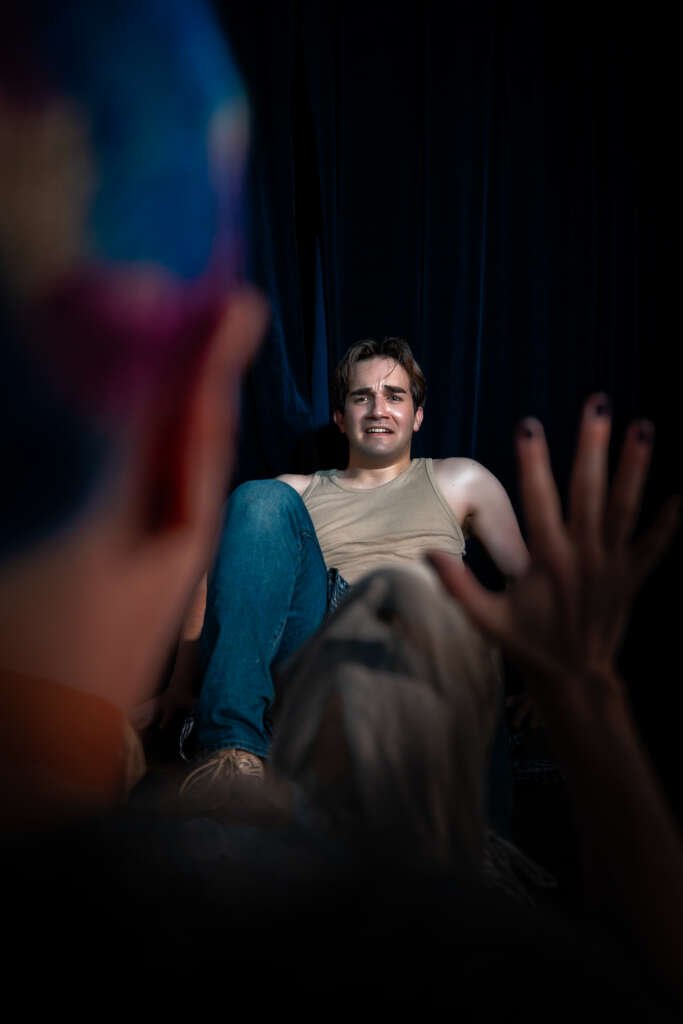
The conversation gradually works through that violence, eventually arriving at new forms of understanding, in true romantic-comedy fashion. And some of the negotiations along the way are as funny and engaging as anything in the aforementioned films (and, at their queerest, considerably more interesting). In one particularly wonderful scene, a game of Twister somehow becomes a debate about vegan meat on pizza (you can probably guess the argument). Simon makes his case with surprising lightness, creativity and patience: vegan meat can taste exactly the same, perhaps even better, and why should you have to be vegan to eat it? It is the closest the play comes to using metaphor, and it uses it to brilliant effect.
After witnessing boobytrapped’s trans take on such a tired trope, I was left feeling like I’d breathed fresh air. It uses the body-swap premise with such unexpected aptness, that it manages to touch on so much with equal profundity: it makes visible the violence of some very specific sexual and gender norms, the alienation of feeling estranged from your own body, and even, in its most beautiful moments, the pleasure and freedom of finding (or creating) a body that feels like yours. But perhaps most surprisingly to me, the play managed to expose what the body swap’s overwhelmingly cisgender history (and romantic comedy more broadly), has so often, and to its own misfortune, overlooked: that social experience is always embodied experience.
Main image: Ermis Makides (left) and Freddie Haberfellner (right). Credit: Valeria Semenova



[…] How boobytrapped turns the tired body-swap trope into something new […]