


“I’m a Scorpio,” is the answer Yoky Yu gives me when I ask about the prominence of sex jokes in her Fringe stand-up show, East Infection — the first of many replies that will make me feel like I’m getting a private stand-up set. It may help that we’re chatting straight after her show: it was a full house, she tells me, and she’s still running on the adrenaline.
Beyond her star sign, however, Yoky has plenty of important (and hilariously worded) reasons for making sex such a central part of her comedy. “First, I feel like it relaxes people, you know? When you, the stage person, are the dirty one. When you go there first, they follow you.”
Naturally, she compares the process to anal sex: “You have to lube [the audience] up first, and do it slowly and gradually. […] I made the mistake in my earlier career to do something a bit too quickly and I lost some of [the crowd].” Stand-up, like (anal) sex, must be a “mutual, collaborative experience”, Yoky concludes.
But sex is more than comedic lubricant. It is also, as she puts it, a “sneaky way to talk about other impossible [matters]”: “I have lots of political sex jokes, like about the Chinese government. I think that’s a subtle way for me to do something that is impossible to do in China.”
She also refers to one particularly brilliant joke from her act (which will remain unspoiled) to illustrate her unusual way of tackling racism. It leads her to conclude: “I found sex a way to bridge communities, race, gender, space.”
Sex may be a conscious comedic and political device for Yoky, but that attitude also reflects what sex has come to mean in her own life. In recounting her sexual explorations, she tells me that she found in sex a way to “connect with the world”. She considers, “[sex] is almost like a language […] somehow, it adds a layer of connection with other people.” No wonder, then, that “talking about [sex] on stage, somehow [has] always been easy” for her.
“Also, because English is not my first language, I don’t feel any shame, you know?” This comment sends us briefly down the rabbit hole of why dirty talk is so much more fun in your second language. Eventually, when we find our way back to the interview, much to my own shame, Yoky is the one who has to remind me where we left off. “It’s the therapist part of me,” she says, in reference to her good memory.
Yoky’s second occupation may come as a surprise to unadvised readers of this article. Rest assured, the same surprise was felt by the gasping, nervous-laughing audience at West Port Oracle’s small basement venue when Yoky makes the same revelation mid-show — after numerous filthy, unfiltered and dark jokes.
I found sex a way to bridge communities, race, gender, space.
The differences between comedian and therapist are obvious enough. But Yoky can just as easily point to the similarities: “In therapy, you’re kind of like a witness to your client’s different parts. And you’re kind of turning the shadows into light. You know, you normalise shame, normalise guilt when you talk about it. Normalise imperfections. I feel like comedy does the same. […] Me talking about my own embarrassment, fuck-ups, my shadows, makes people feel like, ‘Oh, okay, they’re normal.’ And they can also be shameless.”
And there’s a whole lot she normalises in East Infection: sex, queerness and the trauma that can surround both are only some of it. “I think that’s one way that comedy can be therapeutic.” She follows this with a brilliantly unexpected statement: “And also, therapy is such a middle-class thing to do, you know, but comedy is so cheap.”
Price differences aside, the connection between her two occupations goes further still. I point out how remarkably open she is while remaining attuned to her audience. Yoky attributes this partly to her naturally sensitive personality (sometimes, she says, “a bit too sensitive”) and to the balance she strives for between being fully herself and allowing others to be themselves, too.
“[When] you’re somehow trying to be in integrity with who you are but also allowing other people to be who they are, and coexist, there will be attunements and misattunements.”
Although these are two complex therapeutic terms, Yoky tries to explain them to me in the simplest of ways. ‘Attunement’, she says, happens when there’s a mutual feeling of being acknowledged and understood, resulting in connection. ‘Misattunement’, on the other hand, happens when a misunderstanding, gap or friction ruptures that connection. For Yoky, those moments of rupture are inevitable. The really important question, then, is: “How do we recover from that?”
That degree of therapeutic sensitivity is quite the gift for a comedian, particularly one who dives so readily into intimate, sometimes traumatic territory. It may well be what allows her to do so. Fittingly, and with the utmost self-awareness, she concludes that “both careers [therapist and comedian] are a way to connect with people and to heal” from her own traumas. “I feel like I have come a long way to heal myself and to have a thick skin and also a sensitive skin at the same time, you know?”
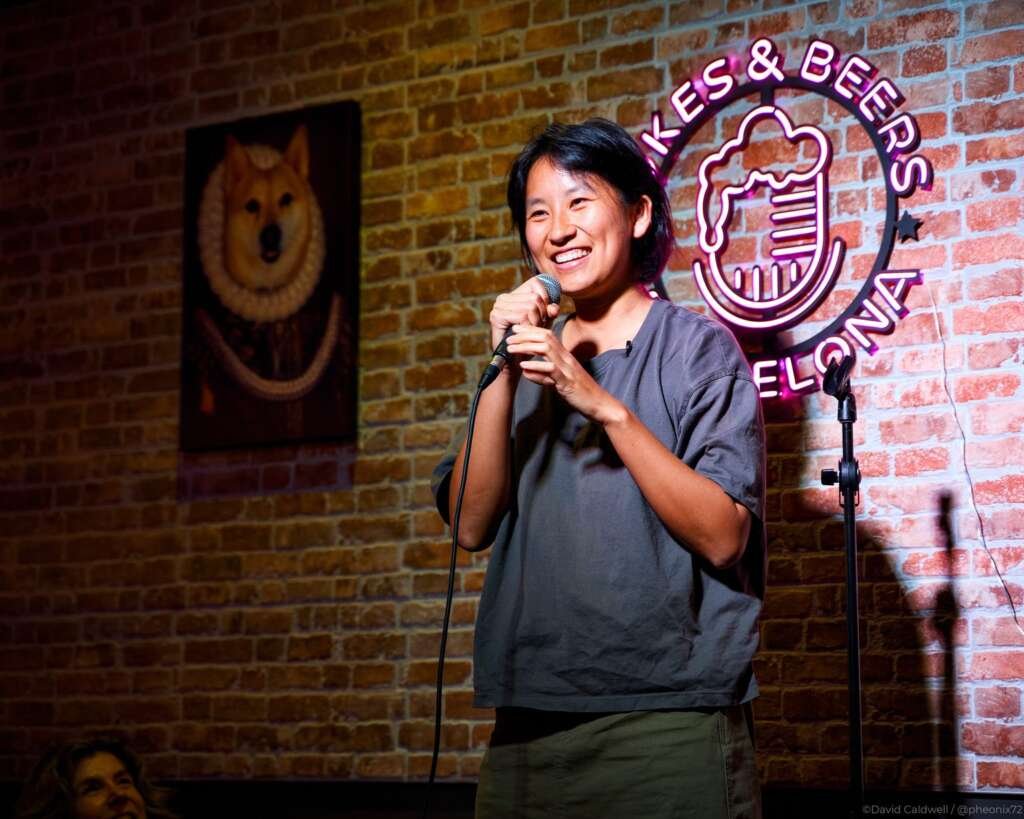
She has also come a long way to “come here [to the Fringe], and to believe in myself and to feel like I’m worth taking up space and worth being seen and heard.”
And there is no doubt that she takes up glorious, unapologetic space in East Infection — entirely in keeping with the show’s precise description: “dark jokes and crowd work from an unfiltered and uncensored/unsafe space”.
Yoky recognises that, while this quality may attract some, it might also put some people off: “I’ve gotten some backlash from the audience before, [saying] ‘Give a trigger warning.’” I jump in to suggest that the show’s description is in itself a trigger warning. She agrees: “It’s an anti-trigger-warning trigger warning.”, and voices yet another assured and well worded point: “Not everything should be trauma-informed. Because, if so, I will be out of my job.”
It becomes clear to me that her refusal to shy away from trauma, taboo or discomfort (sexual or otherwise) is not merely a comedic stance, but one bound up with her personal history and broader philosophy. Coming from China, where she says she experienced the consequences of having no freedom of speech (“You can say some things, but you can’t say lots of things”) Yoky worries about Western societies becoming too quick to turn certain subjects into no-go zones.
She mentions a therapeutic concept called the “window of tolerance” (which refers to ones optimal emotional ‘zone’) and considers: “I think that applies to society as well. It’s how much we can tolerate someone else’s differences, even opposing values, and then still look at them like humans.” Comedy, she suggests, can help widen that window, serving “as a bridge so that people can maybe tolerate differences” — a point that clearly echoes her earlier remark on sex as a comedic language.
Me talking about my own embarrassment, fuck-ups, my shadows, makes people feel like, ‘Oh, okay, they’re normal.’ And they can also be shameless.
But Yoky is far from naive about what that means, or what it might look like in a comedy show. Her aim is certainly not to make her audience agree on any one subject. Perhaps, it is simply to keep us in the room together for a brief moment, recognising one another in our differences and allowing ourselves, for those few minutes, to laugh at them collectively.
She finishes our conversation, fittingly, by turning her critical yet generous gaze back on herself. Enlarging her own window of tolerance, she tells me, has taken “lots of work”, including learning to accept that some shows will be “shitty”, some will be great, and some will come with “a surprise reviewer”.
I’ll leave the circumstances of that surprise to the reader’s imagination. I’ll only say that it turned out to be a fortunate one, for it led to an enriching, hopefully attuned encounter with a therapist-comedian whose extraordinary capacity for connection allows her to turn discomfort, division and shame into points of contact.
And one that left me even more amazed by how, in the rapid-fire breath of East Infection, Yoky consciously and sensitively breaks down shame around sex and trauma, while using sex as a powerful tool for both interpersonal and political connection.
Not a bad use of a Scorpio Sun, I would say.
All images by David Caldwell