


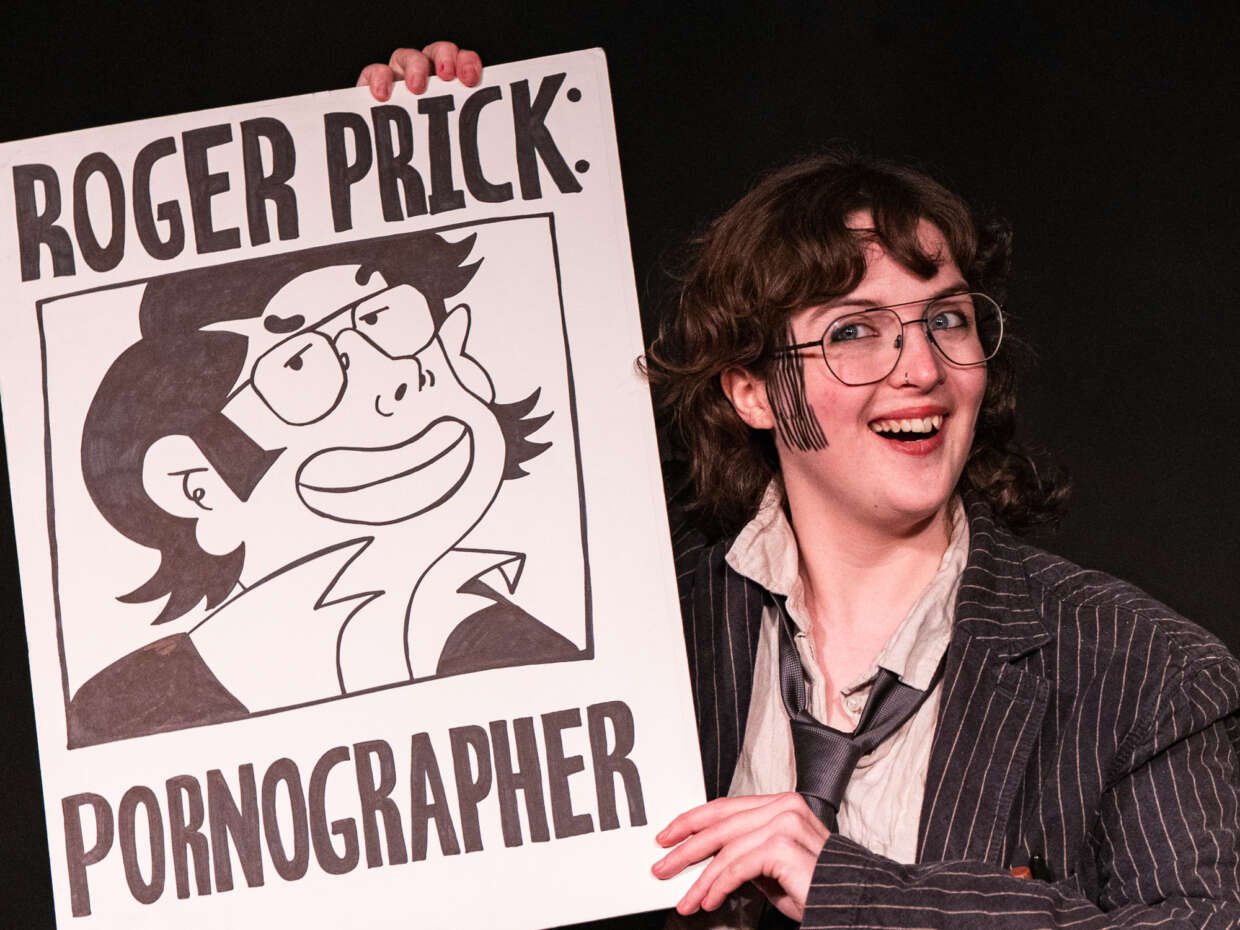
By 18:55 on Saturday evening, there isn’t a spare bum on a seat in Cowgate Hall — which feels rather appropriate for a show called Roger Prick: Sexopolis.
Han Whyte’s sell-out show asks a fairly important question: what would happen if you took a gloriously seedy pornographer from 1970s Soho, shoved him into a time machine and dumped him into the feminist landscape of 2026?
Enter Roger Prick.
With an ill-fitting shirt half tucked into his trousers and half hanging out, a dishevelled tie, cracking sideburns and glasses, Roger looks every bit the man you wouldn’t want to be left alone with at a 1970s office Christmas party. He was a pornographer and erotic novelist in Soho, and now he’s back to relaunch his dirtiest novel — revised and edited for our modern feminist, or as Roger calls them, “awake”, times.
From the moment the drag king and character comedian enters the room, she doesn’t so much play Roger as become him. His eyes scan the audience and land unapologetically on the women. He works his way around the room calling us “darling”, flirting shamelessly and looking people directly in the eye while delivering some of the seediest lines imaginable. At one point, I genuinely felt like Roger was undressing me with his eyes — which is testament, I suppose, to both Whyte’s performance and the fact that I desperately wanted him to look somewhere else.
Roger Prick is funny because he’s a relic. Or at least, we’re supposed to think he is.
There’s an Austin Powers-esque quality to Roger. He’s appalling, but somehow strangely charming; repulsive, yet difficult to look away from. And Whyte commits to him completely. The boldness required to hold someone’s gaze while delivering material this sleazy shows just how comfortable she has become inside the character.
And the audience absolutely loves it.
The laughter moves in waves: nervous chuckles building around a filthy pun before suddenly cascading across the room into proper, knee-slapping laughter. We’re treated to Roger’s erotic poetry — “Roses are red…” quickly descending into an invitation for a snog in the loo — alongside his attempts to grapple with modern feminism.
You laugh. You cringe. Occasionally you want to disappear into your chair.
For most of the hour, that seems to be the game. We are enlightened people in 2026 laughing at this ridiculous relic of 1970s sexual politics. Look how casually he objectifies women! Look how little he understands feminism! Thank God we don’t think like that anymore.
Except… don’t we?

Somewhere underneath all the puns, cardboard props and glorious sleaze, Sexopolis quietly puts two very different sexual eras side by side. And once they’re there, it becomes difficult not to start comparing them.
There’s no question that enormous progress has been made since Roger’s supposed heyday. Conversations around consent, women’s sexual agency and sexual violence have changed dramatically. Roger’s particular brand of casual sexism sounds ridiculous to contemporary ears precisely because attitudes have moved on.
But perhaps that’s also what makes him interesting.
Roger Prick is funny because he’s a relic. Or at least, we’re supposed to think he is.
Because while Roger has arrived in a Britain that might appear sexually enlightened compared with 1970s Soho, 2026 is simultaneously having some enormous conversations about pornography, misogyny and sexual harm.
Misogyny may no longer be wearing Roger’s badly tucked shirt, loose tie and frankly magnificent sideburns — but that doesn’t necessarily mean it left the building.
Since July 2025, pornography services accessible in the UK have been required to introduce age checks under the Online Safety Act. Meanwhile, the government’s own recent research into harmful sexual behaviour among children reported that a third of those surveyed had encountered online content encouraging violence against women and girls.
Roger’s sexual world was one of Soho sex shops, dirty magazines, erotic novels and unapologetically sexist imagery. Ours is considerably harder to summarise. Pornography itself has diversified, from enormous tube sites to independent creators, queer and feminist porn, subscription platforms and performer-controlled content. At the same time, the wider online landscape has created new routes through which misogyny can spread, from algorithmic feeds to influencer culture and the manosphere.
The point is not that sexual culture has simply swapped one form of misogyny for another. It is that some of the questions surrounding sex and power that Roger embodies so grotesquely have not disappeared. They have become more complicated.
Misogyny may no longer be wearing Roger’s badly tucked shirt, loose tie and frankly magnificent sideburns — but that doesn’t necessarily mean it left the building.
There is something reassuring about Roger’s sexism because it announces itself so loudly. You know exactly what you’re looking at. Contemporary misogyny doesn’t always have the courtesy. It can arrive dressed up as dating advice, masculinity content, influencer culture or an algorithm serving increasingly extreme ideas to someone who never actively went looking for them.
That doesn’t mean we haven’t progressed. Suggesting that women’s lives or sexual freedoms are unchanged since the 1970s would be absurd. But progress is perhaps much easier to identify when we’re looking backwards than when we’re standing in the middle of it.
And satire gives us an unusual way into that conversation.

Whyte never stops proceedings to explain why Roger’s attitudes are problematic. She doesn’t need to. She lets him stare us down, call women “darling” and spectacularly misunderstand the modern world until his worldview becomes ridiculous all by itself. Somewhere amongst the filth, there’s even an unexpectedly touching love story involving Roger and a feminist, offering a glimpse of something more human underneath a character who could easily have remained a caricature.
By the time Whyte finally breaks character at the end, taking her bow and thanking us for a sell-out show, it feels strangely jarring to see Roger disappear. For an hour, Han hasn’t just introduced us to him; she has completely inhabited him. A bum on every seat and, judging by the noise in the room, a laugh out of pretty much every mouth. Not bad going for a deeply inappropriate pornographer several decades past his prime.
I walked out with a belly full of laughter but also scratching my head slightly. There was something about the show that I couldn’t quite put my finger on. Then a half-baked thought arrived:
What will people fifty years from now think of us?
Perhaps somewhere at the Edinburgh Fringe in 2076, another audience will be sitting in a cramped room watching some grotesque caricature of a person from the 2020s. Maybe they’ll howl at the manosphere, our relationship with pornography or some aspect of our sexual politics that currently feels completely ordinary.
Someone might walk out afterwards saying, “I cannot believe people actually thought like that.”
And presumably, they’ll be right. But perhaps fifty years after them, another audience will do exactly the same thing.
Time travel is the central joke of Sexopolis, but strangely, it followed me out of the theatre. Roger travels forward from the 1970s and lands in 2026; I left Cowgate Hall travelling further still, wondering what an audience in 2076 might find hilarious about us – and, more uncomfortably, what they’ll be horrified we couldn’t see.
All images by Paul Gilbey