


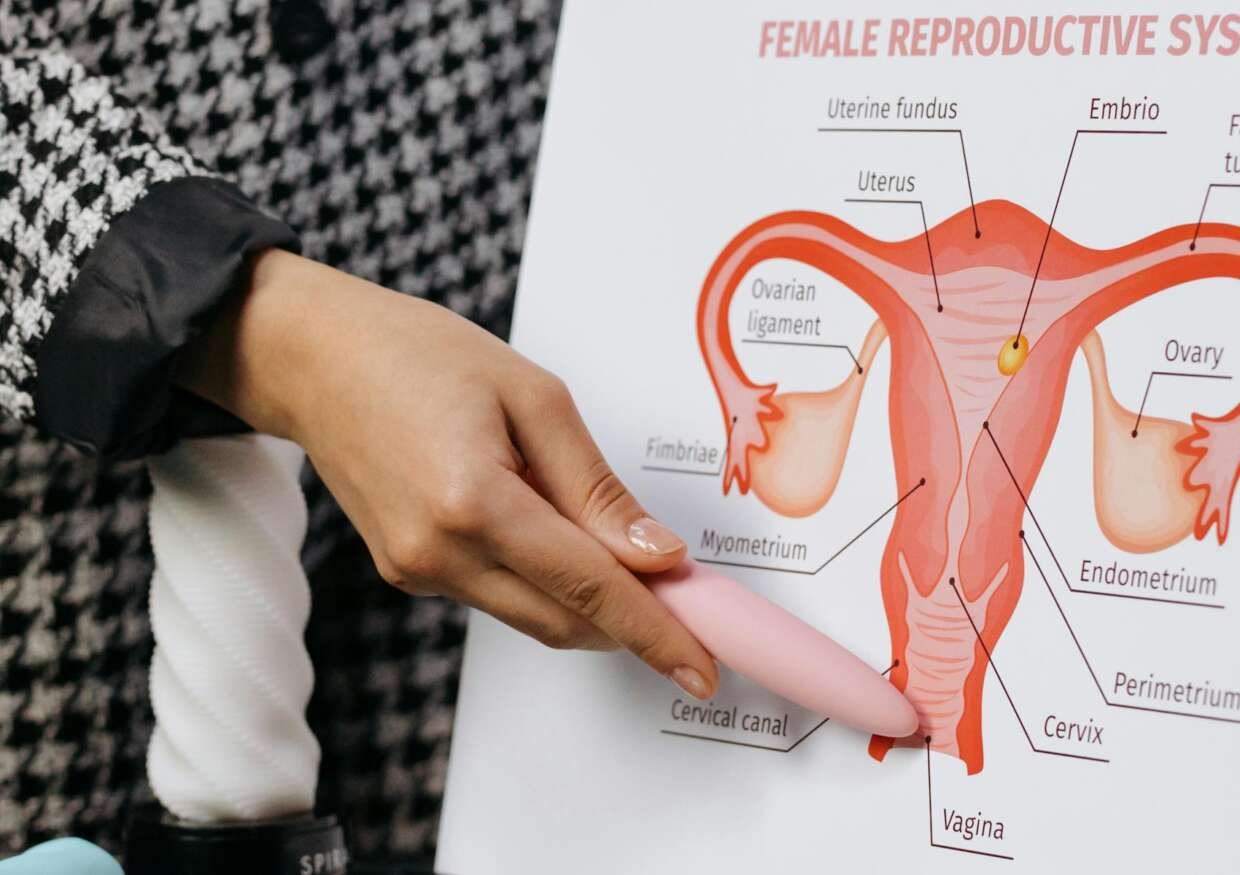
One word.
Vagina.
That wasn’t so hard, was it? Yet, so many skirt around the word, looking for anything else to say instead, anything but vagina. Which hardly seems like much of an issue, right? We use euphemisms, slang and innuendo to describe topics we’re uncomfortable with all the time, so what’s the big deal?
Well, that discomfort with using the word “vagina”, and more widely, anatomical terminology for genitalia and reproductive organs, reflects a wider issue in our society which we can’t ignore. To explore this, let’s take a look back at history.
Why vagina?
The Latin origin of the word means “sheath”, as in the resemblance between sheathing and unsheathing a sword and penetrative intercourse. This offers a reductive view of the vagina, focused on its receptacle function rather than recognising its two-way nature (i.e. a canal that facilitates menstruation and birthing as well as insertion).
So, the sexual connotations of its original meaning could be what’s lingered in today’s language and again shapes how overly sexualised the perception of “vagina” is, hence people’s aversion to saying the word.
Regardless, this is the established anatomical terminology, so we’re kind of stuck with it (for now, at least).

Why don’t people want to use the terms?
Hajer Adrwish, Programme Coordinator at the UK Relationships and Sexual Education (RSE) programme-provider Split Banana, believes that a big reason people don’t feel comfortable using the biological terms for genitalia is that generally they were taught not to: “If you’re not teaching people to use it, it’s not going to be used.”
Often, avoiding biological terms is an attempt at “protecting childhood innocence” due to adults’ overly sexual perception of these terms. But the irony is that this censorship can actually do more harm than good. Instilled in many of us from a young age and reinforced as we grow up, it often creates feelings of shame carried into adulthood and negatively impacts sexual and reproductive health, and overall wellbeing.
Fadima Aroua, Diversity and Inclusion Policy Advisor at the University of Antwerp and a youth worker with an academic background in translation, gender, and diversity studies, explained how the taboo around using words for female genitalia extends to societal attitudes towards women’s health topics, namely menstruation. “It’s a biological occurrence, so, normally, the denotation should be neutral, but the connotation is very… layered.”
Furthermore, if people dare to use the term vagina, it’s often to refer to the entire structure of female genitalia in a catch-all way, hardly ever to the individual parts respectively, i.e. the vulva vs vagina as two distinct parts, serving different functions. This inaccuracy itself causes its own issues.
We name things for purpose, everything has a name, and it’s important to use the correct one.
This kind of shame is not unique to the English language. Growing up in Belgium, Aroua mentioned some of the obscure slang used in French and Dutch to refer to genitals and menstruation, and the confusion this brought when trying to discuss menstrual symptoms: “There must be another word, but I don’t know what it is… I don’t know if it’s appropriate… I can’t speak about my body in a proper way,” Aroua recounted thinking.
Using anatomical terms accurately
Research from the Eve Appeal showed that 65 per cent of women felt uncomfortable using anatomical words and instead favoured euphemisms. Other research found women’s use of euphemistic or childish terms such as “down there” or “vajayjay” was often linked to negative perceptions of body image and feelings of shame or embarrassment.
In contrast, using biological terms was associated with more positive health outcomes because being comfortable with these terms often indicated openness to discussing their health. The study also highlighted that being able to use the anatomical words for their genitals can also give children and young people the tools to effectively communicate about their bodies and experiences, which can aid in seeking help and support.
For instance, Aroua mentioned how a lot of girls she’s worked with through the local youth project “Girls in the City” (GITC) (which offers opportunities for young girls to connect through fun activities) were hesitant to talk about menstruation openly. However, following a campaign that GITC led to tackle this stigma, many girls and young women were better able to identify what was and wasn’t normal regarding their sexual and reproductive health, and it helped encourage some even to see a gynaecologist for the first time.
Hajer said: “We name things for purpose, everything has a name, and it’s important to use the correct one.” She emphasised how it can often bring clarity and minimise the likelihood of miscommunication and mistakes. Over time, things can be changed and improved with knowledge and education in both clinical and educational settings, but she explained how this can only really be achieved if we use the correct terminology and support people in doing so.
She also adds that her faith guides her work, explaining the significance of seeking knowledge and education in Islamic culture, particularly in medicine and healthcare, and how being knowledgeable aligns with Islamic beliefs and heritage: “[A] core [tenet] of Islamic care is to help people, to prevent harm — sanctity of life is very important, and one of the things to achieve that is to give people autonomy and the skills to be able to care for one another,” Hajer shared.
Modelling change
Hajer believes that it’s worth starting early, i.e. for professionals and parents to use anatomical terms for genitals with children. “Everyone has a right to decide but you also have to give them the skills to be able to advocate for themselves,” she said. That way, we can model the change we want to see by normalising the accurate use of these terms in our everyday lives, and encourage others to do the same.
It’s important to think about what we mean, the impact our words can have when we talk about our bodies, and the messaging we send to ourselves and others. How this shapes our self-perception and expression, especially from a young age.
Vagina, vulva and other anatomical terms aren’t “dirty”, vulgar or shameful words to use. Instead, let’s normalise using biological terms to refer to all body parts, including genitals, because they’re a part of the body and therefore part of our health too.
This article is part of Pillow Talk Scotland’s Bold Type Fellowship, a programme supporting emerging writers and journalists to publish bold, well-researched stories about sex and relationships. The Bold Type offers mentoring, workshops, and paid writing opportunities, with a focus on supporting those who have faced barriers to entering the media.
The fellowship’s first round was delivered thanks to funding from Women’s Fund for Scotland.
Want to keep up with our latest stories? Subscribe to our free newsletter for new writing, events, and resources.