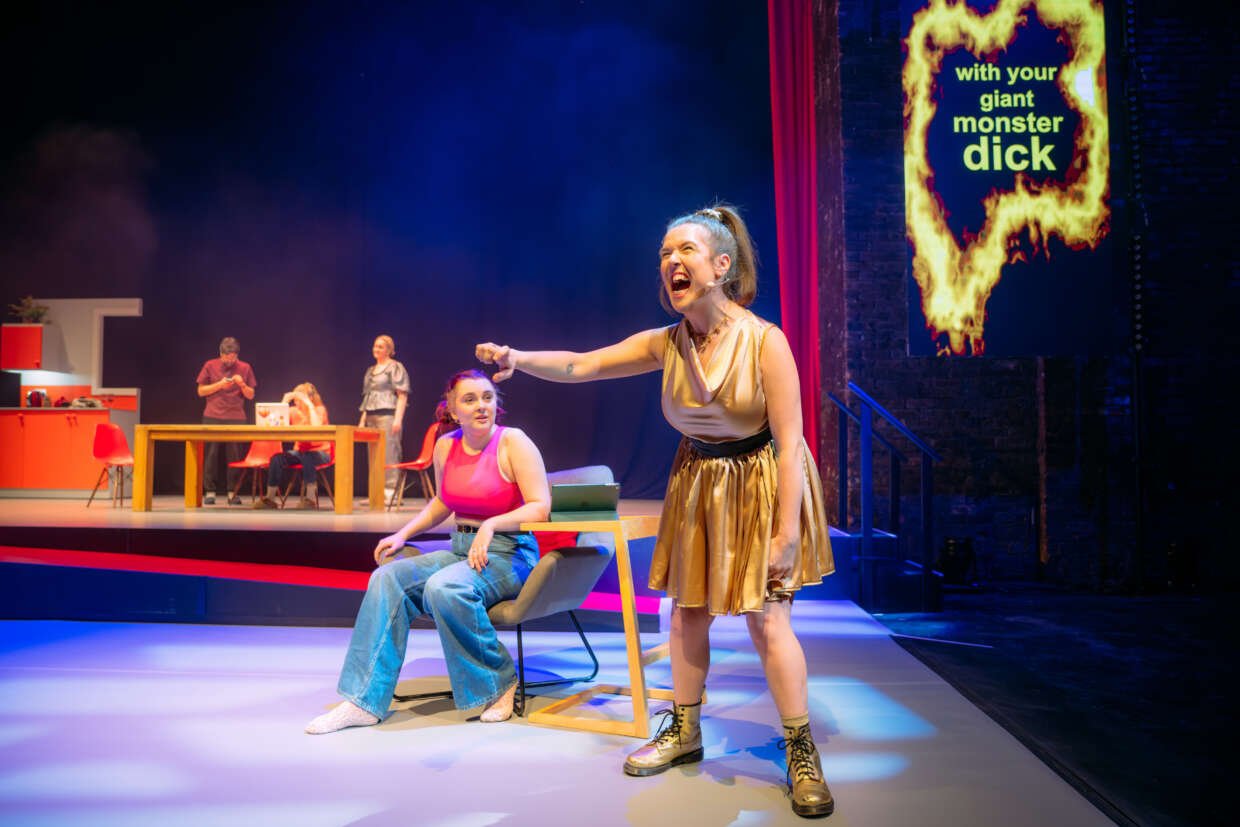
Yes, we fuck.
This was the sentence that launched a seed of an idea, an 18-month writing process, and what eventually became the show (We indulge in) a bit of roll play, which ran at the Tramway in Glasgow in February 2026. It was our moment to come together as disabled artists and create a production so large and in your face that you couldn’t ignore the fact that actually yes, disabled people do have sex.
Sex and disability is a topic that rarely finds its way in the cultural landscape. It’s not often that you’ll find disabled people depicted as sexual beings in literature, on stage or on screen in the same ways that you do able-bodied people. Sex and disability is often a tool to garner sympathy, sometimes for fetishisation, and to serve as (sigh) inspiration porn. The exclusion of disabled people from stories which explore sex and sexuality is painfully obvious to those who want to see themselves, and due to on-going stigma, disabled sex is still seen as taboo within society.
Despite the fact that 24.1% of the Scottish population have a limiting long-term health condition or disability, and 16.8 million people UK-wide have a disability, this demographic seems to be glaringly absent from stories which explore sex, intimacy and desire in all of its joys, complexities, messiness and uniqueness. Whilst society is becoming more open to concepts around non-monogamy, exploring kink, and the ever-growing fascination with the genre of fairy smut, it seems wild to me that there are so few representations of disabled sex.
As a playwright, sex, sexuality and pleasure activism have always been the foundations of my artistic practice. Truth be told, I’m kind of a sex nerd. I’ve read a lot about sex, studied sexual health, attended workshops on various niche topics from masturbation to kink and fisting, and even trained as a sexual health educator. So when Artistic Director of Birds of Paradise Theatre Robert Softley Gale asked me to be a co-writer for his new show about sex and disability, it was a very enthusiastic YES.
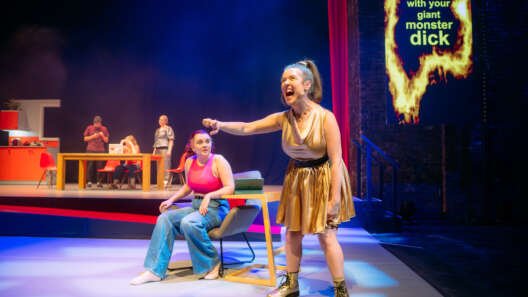
Birds of Paradise Theatre (BOP) is a disabled-led theatre company in Scotland which has been running for over 30 years. BOP makes theatre about disabled people, but crucially it is created, developed and produced by disabled people. As a disabled playwright who writes about sex, I knew that this was a perfect opportunity to put disabled sex at the forefront and on the stage, and was delighted to be able to write the script collaboratively with writers Robert Softley Gale and Hana Pascal Keegan. We knew from the start that we wanted to tell a story which unapologetically centred disabled desire and pleasure. That story became (We indulge in) a bit of roll play, starring Ed Larkin and Rosie Jones.
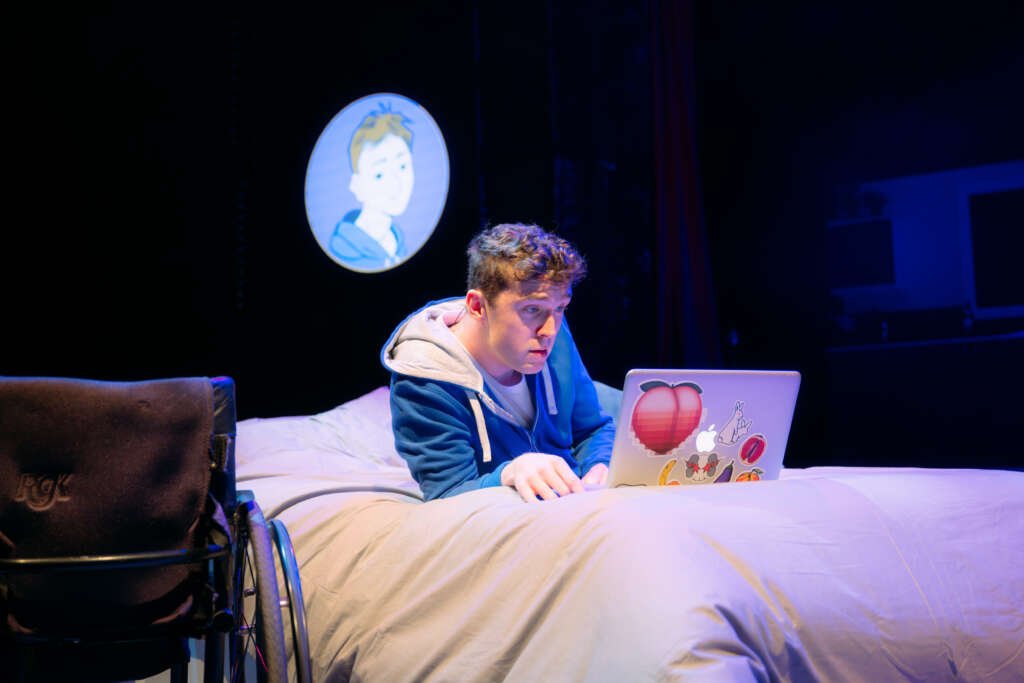
The play follows the story of Ben (Ed Larkin), a young disabled man who is navigating the world, his agency, his relationship with his parents, and a situationship all in one. After an incident at a sex club in Liverpool, Ben’s confidence is knocked, and he retreats to his bedroom. He’s angry, he’s frustrated, he’s lonely. And he’s definitely horny. When he catches his parents at it on the kitchen table one night (everyone’s worst nightmare), tensions rise and begin to spark uncomfortable conversations around sex, intimacy and relationships. Talking about sex with your parents is horrific at the best of times, but when you’re disabled it’s a whole other level.
And Ben definitely doesn’t need the sex talk, he’s been making bank on OnlyFans. And as an online creator, he has the power to be seen as he wants to be seen. His angles, his poses, his edits. His choice.
Who needs to leave the house when you’ve got thousands of subscribers wanking over you on the internet?
…right?
Enter our mysterious trickster CripGod (Rosie Jones), ready to challenge Ben’s self-imposed isolation and bring a little bit of chaos. What transpires from there are difficult, complicated conversations around sex and disability, the pain that comes from the death-by-a-thousand-cuts that comes from the exclusion from spaces that disabled people face all too often within society.
And that was another point that myself, Robert and Hana really want to hit with this play: unadulterated disabled rage. We are currently at a point where disabled people are having vital benefits slashed, put through torturous and extensive assessments for PIP, struggling to access work opportunities, living in cities where moving freely and independently is dangerous, and regularly coming up against public spaces that were never designed with disability in mind. It’s frustrating, it’s infuriating. It’s exhausting.
In the play, CripGod says:
“See, there’s this thing that happens when you’re disabled. You get these moments – usually at 3am, sobbing into your pillow – where you think “Does anyone else feel like this? Am I the only one who’s angry, scared, horny, exhausted?” And the answer is no, you’re not. There’s thousands of us, millions maybe, all having the exact same 3am crisis.
But here’s the problem – we’re isolated, separate, because the world’s built to keep us apart. Can’t get on the bus. Can’t afford the taxi. Can’t get in the building. So we’re scattered. Atomised. All these brilliant, furious, filthy-minded crips, separated by postcode lotteries and benefits assessments.”
When Ben is excluded from wrestling in an inflatable pool filled with baby oil, it might at first glance seem like no big deal. Maybe they ran out of time, you know? Or it was just an oversight. But when disabled people are time and time again excluded from participating, brushed off and ignored, that thousandth cut can feel like a slash to the gut. Like you’re not someone who gets to wrestle in an inflatable pool, or someone that’s welcome in sex.
Like someone who doesn’t get to fuck.
And the problem when you are excluded or not welcomed into these spaces is that you are not seen. You’re not represented, you’re excluded from the narrative, and it can feel like you are not seen as a sexual person or even desirable. It can often feel like being gaslit when events say that everyone is welcome, but don’t provide step-free access, accommodate sensory needs, or find ways to successfully communicate with everyone. Which is unfortunate because as everyone knows, communication is the best lubrication.
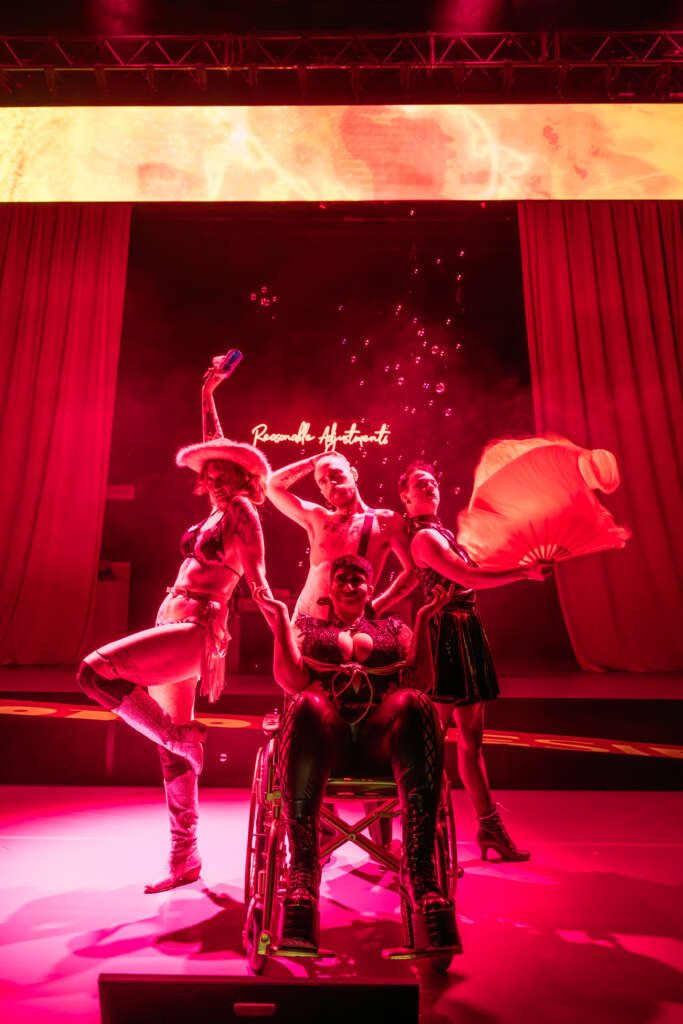
What unfolds at the end of the play, as the kitchen and domestic setting begin to dissolve, Ben and the audience are transported into an imagining of what an accessible sex club could look like, bringing on stage burlesque and cabaret artists such as Eilidh Ellery, Freak the Clown, Roxy Nova, Myla Corvidae, and Indrid Heron. An outrageously bold, audacious and sexy epilogue performance filled to the brim with disabled artists which sounds out the final, glorious rallying cry to celebrate disabled bodies and disabled sex, sexuality and desire.
Because yes, actually, we do fuck.
This article is part of Pillow Talk Scotland’s Bold Type Fellowship, a programme supporting emerging writers and journalists to publish bold, well-researched stories about sex and relationships. The Bold Type offers mentoring, workshops, and paid writing opportunities, with a focus on supporting those who have faced barriers to entering the media.
The fellowship’s first round was delivered thanks to funding from Women’s Fund for Scotland.
Want to keep up with our latest stories? Subscribe to our free newsletter for new writing, events, and resources.
All images by Mihaela Bodlovic