





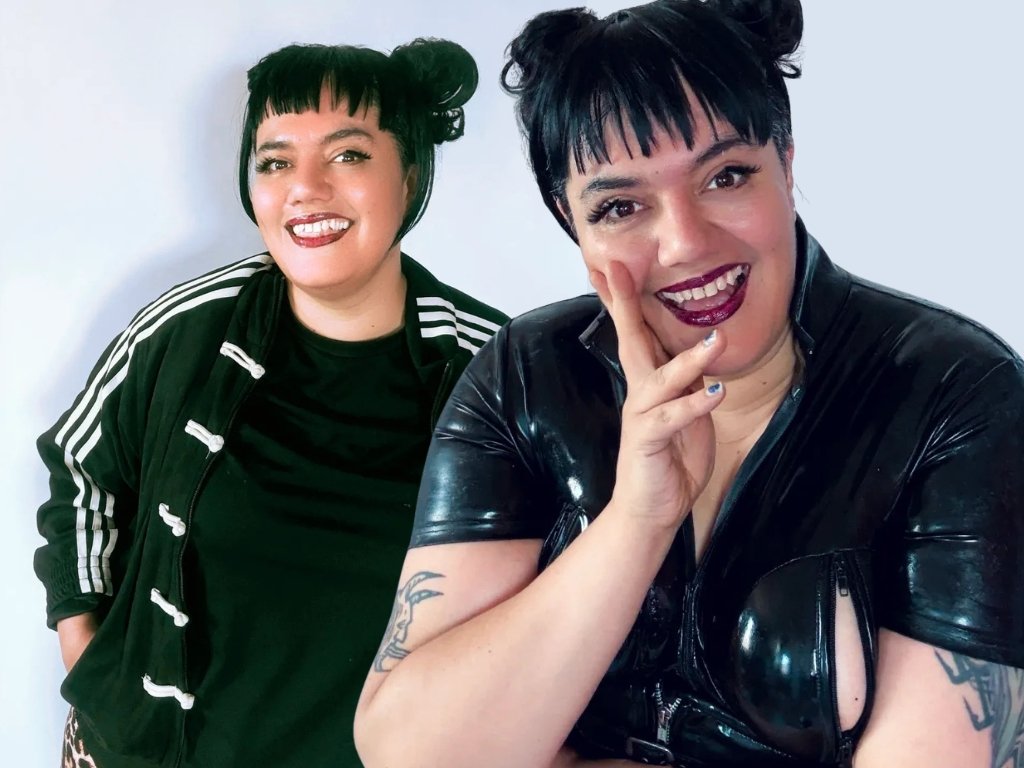
Comedian, former dominatrix and sex therapist Becky Fury has spent years hearing about the parts of people’s lives that rarely make it into polite conversation.
In her Fringe show Sex!, those experiences become the starting point for an hour that is filthy and funny, but also interested in the less obvious questions underneath: why people seek submission, what kink can reveal about gender, and what happens when desires we’re told to suppress simply find somewhere else to go.
We spoke to Fury about using comedy without kink-shaming, the appeal of giving up control, and why she thinks our ideas of what counts as “normal” deserve some scrutiny.
Something we found interesting about the show was that less commonly discussed sexual desires weren’t presented as dark or shocking. They were mostly funny and human. Do you think comedy can help remove some of the shame around kink?
When I wrote the show, I was very aware that I didn’t want to do a show that involved kink-shaming.
Kink-shaming is a rather odd concept, because I understand the idea behind it, but a lot of people enjoy the shame. That’s part of the kink. So saying we shouldn’t kink-shame people, in a way you’re losing the essence of the kink.
Somebody wants me to blackmail them at the moment. That’s their kink. So I could include things in the show where they’re being humiliated and exposed, but that’s obviously a consensual kink.
In terms of comedy, comedy involves getting to a point of consent with the audience and the person telling the story or the joke. By getting that consent, I think you basically remove shame and bring something into the light, because people have agreed that they understand the thing in order for them to laugh.
You could also just do a whole show where you’re laughing at people’s kinks. I think they can be laughed at, but I also think it can be a little bit cheap just to laugh at people’s kinks because they’re different.
I think difference should be celebrated.
I’m very open-minded and I want people to be more open-minded. I’m not going to create something where we’re giggling at somebody because they’re a weirdo. That isn’t my attitude.
You’ve worked as a dominatrix, sex therapist and comedian. What have those different roles taught you about what people are actually seeking through sex and intimacy?
The thing about comedy is that I think, in some respects, it’s antithetical to sexual experience.
When people want to have a deep, intimate experience, they don’t necessarily want comedy in that, because comedy is a kind of distancing technique. You take a step back and observe something, whereas with intimacy people really want to be in the moment.
Although when people are laughing, they are in that moment.
So there is something about direct, authentic human experience that ties all of those things together. Creating authentic human experiences that create connection between people is something that I like doing, and I think that exists within all of those different areas.
A lot of the time people also just want to play around. They want a release from the restriction of having to play certain roles. They don’t necessarily want to go on some huge journey of self-discovery. Sometimes they just want to have that experience and then go back to their normal life.
You talk about male clients who wanted to step outside conventional ideas of masculinity, whether through submission, femininity or giving up control. What, if anything, did that teach you about gender and power?
I’ve been gender non-conforming since I was seven years old – consciously. That was before all the gender non-conformity stuff became quite mainstream, so it’s something I’ve been interested in for my entire life because it’s part of me.
I think what people are doing, sometimes, is trying to find a pathway towards a more authentic identity, but they don’t necessarily know that’s what they’re doing.
Quite often people will take a couple of steps down that path because they need a release, and then they want to come back to their normal life. They don’t necessarily want to get into the depth of the authenticity of their identity.
For them, sometimes it’s just having fun and having a release from the restriction of having to play these roles.
When I was seven, I wanted to be a boy. When I actually unpack what that meant, it probably meant that I wanted to do boys’ stuff and I didn’t want to have to conform to gender norms around being female. But obviously, as a seven-year-old, I didn’t understand that. I just said I wanted to be a boy.
People don’t necessarily have the words for what they’re experiencing. The only words people have are the words they’re given, and sometimes those words don’t quite describe the actual experience.
Having encountered people’s private sexual lives so closely, what do you think people misunderstand most about kink?
I think people think it’s something that hurts people. They don’t understand the consent, and they don’t understand pain as pleasure, so they completely misunderstand the experience that somebody is having.
A lot of the time people do kink to relax. People from outside the world of kink might see the practices going on and think, “That looks really stressful. Why would you do that?”
And actually it’s almost the opposite of what people think it is.
When people are restricted with ropes, for example, the experience they’re looking for – if it’s done properly – is liberation. In that moment they can actually be free because they’re restricted.
For some people, particularly neurodiverse people, they might need something like that in order to let themselves relax and float off.
We’re often very eager to find an explanation for why somebody has a particular kink or fantasy. How useful do you think that is? Do we sometimes overanalyse where our sexual desires come from?
In some ways, it’s almost the opposite, because people don’t want to think too much about it. They just want to enjoy the experience. They don’t want to break it down.
But when you actually start to break it down, that’s when you can get breakthroughs in terms of understanding more about yourself.
When you do sessions as a dominatrix, quite often people are able to afford very expensive sessions, so they don’t necessarily think they need to make a change in their life. They’re making enough money to get by, so they don’t necessarily want to get too much into the psychology behind what they’re doing.
Some people want to take that journey and actually integrate these things and change. But quite often people don’t. Sometimes they just want to change costumes and do things in quite a superficial way – and that’s fine as well.
Your comedy also deals with race, identity and politics. Do you see sexuality as another place where those bigger questions about identity and power play themselves out?
In the show I talk about political correctness. One thing I’ve noticed from doing kink is that a lot of the stuff people are told they shouldn’t say in real life, they end up fetishising and turning into a kink.
There’s stuff around race, for example, and some people will say, “You can do whatever you want within kink, nobody should be censoring it.” I’m not going to censor it, but I don’t encourage people to play with some of those ideas because I think you can end up just taking something like racism and putting it somewhere else where nobody can find it, and then playing with it in a different way.
I think it’s important to deconstruct these narratives because they can be really dangerous.
When I talk about these things in the show, I want people to think about them holistically rather than doing this very superficial thing of saying, “I’m going to get rid of these narratives from my speech,” or telling other people they shouldn’t say something.
What you’re not necessarily doing then is communicating why, or changing the way somebody thinks.
That’s part of why I’m doing the show. The first time I performed it, it was almost cathartic to get all this stuff out of the shadows and bring it into a public, vanilla space and talk about it.
These are things that are bubbling away underneath the surface of what people present as polite society.
You’ve encountered a much wider range of sexual interests than most people probably hear discussed openly. Has that changed your idea of what counts as “normal” when it comes to sex?
I’ve always been very, very broad-minded, which probably comes from the fact that I was gender non-conforming.
From quite an early age, I’ve always had an understanding that what is “normal” isn’t necessarily normal. That’s just an attitude I’ve carried with me.
I also think people are much more comfortable talking about these things now. A couple of years ago, I don’t think I would have been as comfortable doing a show saying, “I’m a dominatrix,” and not expecting it to impact on every other aspect of my career.
Now I can do that.
What other Fringe shows have you seen that you’d recommend?
You know what? I haven’t seen any other shows! It’s a bit of a mad schedule. I don’t tend to get out and see much, although I’ll probably see some things in the last week.
In terms of stuff I’ve seen recommended, I’d suggest Coco the Time-Travelling Tart.
What I like about it is that it exists outside a lot of the current pigeonholes. It’s not really a drag character. It’s not a trans character. It’s just this guy wearing a dress and doing a character.
It exists outside of classification. People like to understand things by classifying them, and it doesn’t fit into that classification.
I like that.


[…] Becky Fury on kink, comedy and what we call ‘normal’ […]