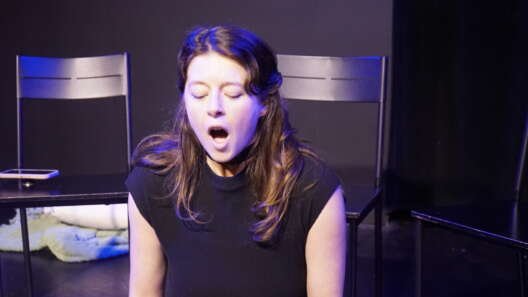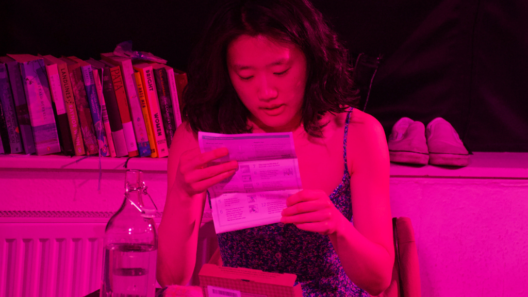



Who amongst us has not found themselves yearning for a distinctly underwhelming and unavailable lover? Someone who inexplicably occupies your dreamscape in spite of their lackluster skills or hygiene? Magalie Rouillard-Bazinet’s Homecumming, and Harriet Richardson’s Creep are two shows that deal with this particular flavour of longing.
Homecumming is (in part) a show about how being in love with someone doesn’t automatically mean they can give you the kind of orgasm you crave. Magalie craves the volcanic overwhelm of the vaginal orgasm, the limit experience of feeling like you’re slipping into a vortex. Easily orgasmic from an early age, she enjoys a range of erotic experiences and finds it easy to meet prospective lovers. In Homecumming, Magalie offers an engaging account of two particularly formative relationships from her early twenties; torn between two men—a French karate champion (SuperEuro), and a British acrobat (Circus Boy)—Canada’s two solitudes have never been sexier or more fascinating! Magalie imagines herself as the fecund shores of North America vied over by two historic powers. While SuperEuro offers her linguistic intimacy and superb sex, Magalie pines for the under-showered anglophone Circus Boy. For Magalie, the chronically unavailable and less suitable man proves to be a lingering phantom, the man under the bed that she can’t quite relinquish.
In Maggie Nelson’s landmark work The Argonauts, she writes candidly of her interest in anal sex and notes the following: “I am interested in the fact that the clitoris, disguised as a discrete button, sweeps over the entire area like a manta ray, impossible to tell where its eight thousand nerves begin and end.” Homecumming is a show that reckons with a similar fascination in the sense that the vaginal orgasm is the core sensory experience that anchors Magalie’s performance. More than being truly understood in her first language, it is in experiencing this particular type of orgasm that she finds belonging, fulfilment, and joy. When Magalie suddenly finds herself unable to experience those orgasms, she slips into a deep depression.
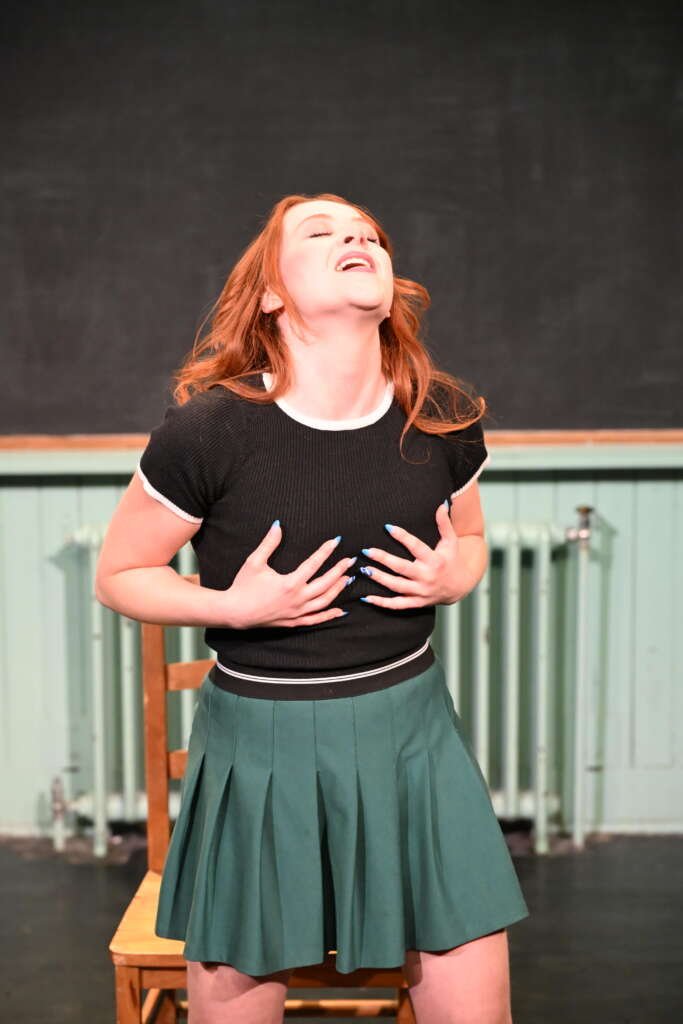
Homecumming is performed in the unique setting of Summerhall’s Anatomy Lecture Theatre, a space particularly well-suited to intense, one-person shows where the performer can eyeball the audience at close range. But it is also a panoptic space, one that can feel relentless and punishing for the performer and the audience. It is a space that exposes everyone, and in this respect the Anatomy Lecture Theatre becomes a kind of crucible for how much the performer is willing to give. This setting works well for Rouillard-Bazinet, whose bounce and luminosity contrasts with the feral, slavering persona that emerges via her vaginal alter ego she dubs Antigone. By intimating that Antigone is both her vagina and a kind of id-like voice of desire, Rouillard-Bazinet captures something of the weirdness of what it can mean to exist as a woman who expresses her sexuality fully and makes it a tool (in the best sense) for performance.
I like shows that discuss femininity and sexuality as a kind of double-edged sword, how passions can rule you, how desire can be motivated by something other than arousal, and how being conventionally pretty can mean it’s easy to pick up sex partners when you want them. But that realisation about how sex isn’t just about satisfaction, that it can be an experience about belonging, about closeness, and how it can slake the gaping maw of loneliness—that realisation often comes later, after your twenties. Losing your orgasm is a kind of alienation from the body, as potentially traumatising as losing one of your senses. If we think about anorgasmia (the formal term for the inability to achieve orgasm) as a loss of one of the senses, it can make us realise how it shouldn’t be shameful and this is part of Homecumming’s power, that it pushes past shame to explore what is underneath sex, desire, and orgasm.
Harriet Richardson’s Creep delves into the pleasures and pitfalls of obsession at a distance. While Richardson’s is a different flavour of longing than that of Magalie’s for Circus Boy, what these two shows share is an acknowledgement of longing as a driving force, even when its object is a largely unsuitable man.
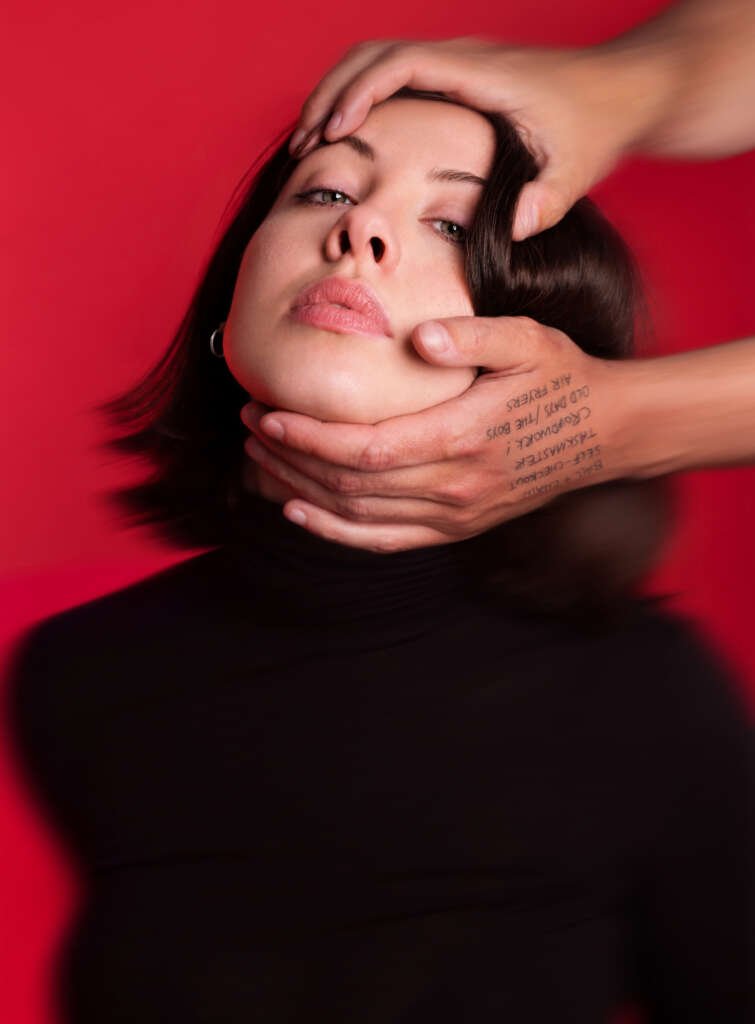
For Harriet, this unsuitable lover is an unnamed male comedian, who slides into her DMs after she garners notoriety for conducting a durational performance: going on 100 virtual dates in a single day. In her auto fictional novel Break.Up, Joanna Walsh observes that “stalking’s the aesthetic of our generation” in relation to her protagonist’s never quite consummated affair conducted largely online, via email. This observation could also apply to Creep, where Richardson dissects her own propensity for obsession, ultimately choosing to make work out of her own anguish.
In this sense, Creep is both a highly modern account of what it means to be a woman in public, subject to all manner of comments on her physical appearance (a number of which become part of the show in a series of hilariously edited PowerPoint slides), and an artwork in the spirit of Sophie Calle’s Suite Venetienne, where following a prospective lover’s movements becomes the spur for performance and a photographic series.
Homecumming and Creep are shows made by and about women who have sex with men, but men are not at the centre. What emerges in both shows is a fierce sense of self-acceptance and how hard won this has been for both artists. Rouillard-Bazinet and Richardson have both undergone profound reckonings through their experience with longing, and by placing their vulnerabilities on stage they are sharing what it means to make art with all of your experience.