

Self-care note: This wrap-up includes discussion of women’s health, miscarriage, racism, anti-LGBTQIA+ policies and behaviours, gender based violence, and more. If you find this distressing or triggering, remember to take it at your own pace. You may prefer to read small sections, wait until you feel ready to read it all, or choose not to read it at all.
1. MPs back bid to block EHRC trans guidance 🏳️⚧️
More than 100 MPs have signed a motion calling for the Equality and Human Rights Commission’s latest guidance on single-sex spaces to be revoked.
The guidance, issued after last year’s UK Supreme Court ruling on the legal definition of “woman”, advises organisations to consider alternative single-sex service options for trans people. LGBTQ+ campaigners say the approach risks excluding trans people from spaces and services they have used for years.
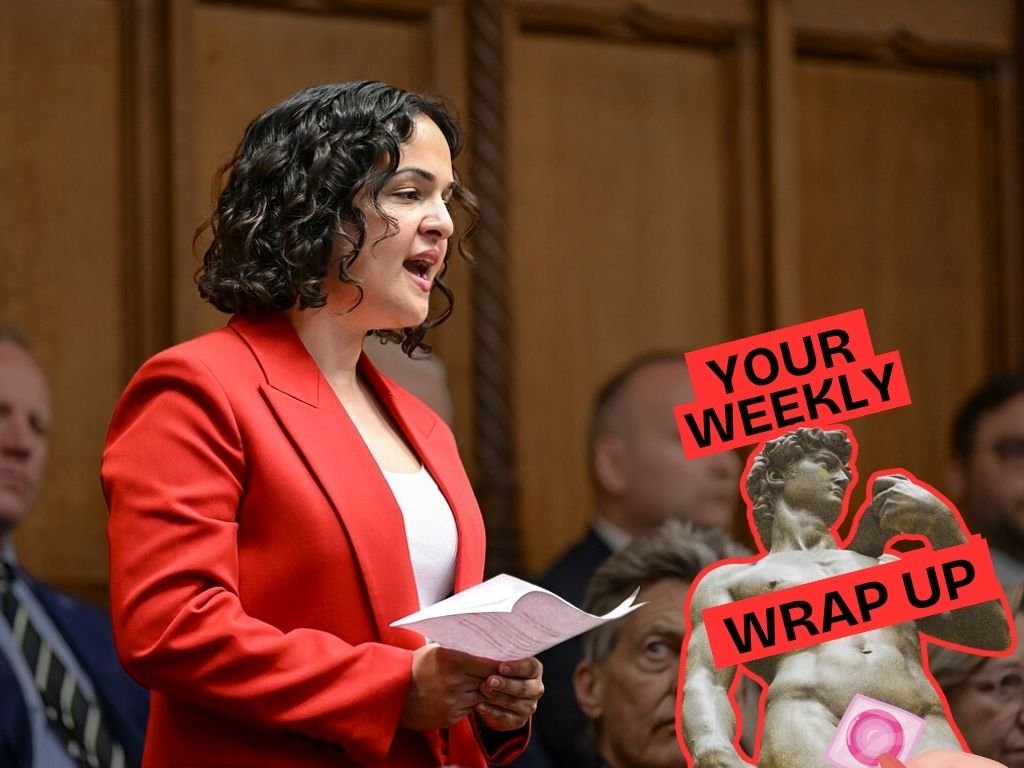
Labour MP Nadia Whittome, who tabled the motion, said the code could put trans people at increased risk of harassment and violence. The Trans+ Solidarity Alliance described the guidance as “unjust, unworkable and unacceptable.”
Source: Attitude
2. UK maternity services continue to let people down, new analysis finds 🤰
An analysis conducted by Sky News and Ipsos of more than 377,000 social media posts from across the UK found that maternity services continue to fail women and families.
Only 21 per cent of the posts analysed about maternity services were predominantly positive in tone, while 47 per cent were predominantly negative.
Specifically, 48 per cent of posts discussing how pregnant people were treated by staff, 56 per cent of those discussing postnatal care, 66 per cent of those discussing miscarriage, and 71 per cent of posts discussing race were negative.
Source: Sky News
3. ‘Widespread’ gender bias in family courts, analysis shows ⚖️
A new report published by the nonprofit organisation Right to Equality found ‘widespread and concerning evidence’ of gender bias and victim-blaming in family courts.
Of the 91 family law judgments analysed in England and Wales, 66 contained victim-blaming language, and many also included rape myths and stereotypes, the report said.
For instance, mothers were scrutinised more closely than fathers, whose conduct was often minimised.
Dr Charlotte Proudman, a co-director of Right to Equality, said:“This report gives voice to what victims have been telling us for decades: bias is real, it is embedded in the family justice system, and it is shaping decisions that affect children’s safety, resulting in irreparable harm.”
Source: The Guardian
4. UK government pushes tech firms to block nude images on children’s devices 📱
The UK government has given technology companies three months to strengthen protections preventing children from taking, sharing, or viewing nude images on smartphones and tablets.
Speaking at London Tech Week, Prime Minister Keir Starmer called on companies such as Apple and Google to activate existing safety features by default or develop new tools to protect under-18s. The government says it will consider legislation, fines, or other penalties if firms do not comply voluntarily.
Supporters argue the move could help tackle online grooming, sextortion, and the sharing of self-generated sexual images among young people. However, privacy and digital rights groups have raised concerns about how the measures could be implemented and whether they could lead to increased age verification or surveillance.
Source: BBC News
Like what we do? Help us do more!
Pillow Talk Scotland is small, independent and community-led charity.
If you value having clear, shame-free storytelling on sex and relationships, please consider supporting us.
→ Make a one-off donation
→ Become a monthly supporter and help us make room for pleasure across Scotland
5. Italian campaign calls for assisted reproduction access for all 🍼
Former Italy footballer Alia Guagni has become the face of a new campaign calling for single women and women in same-sex couples to access medically assisted reproduction in Italy.
Guagni, who had her daughter through fertility treatment in Spain, said she would not have been able to become a mother in Italy because she is single. Assisted reproduction (sometimes called fertility treatment) includes medical procedures such as donor insemination and IVF to help people conceive. Under current Italian law, these treatments are limited to adult heterosexual couples who are married or cohabiting.
The campaign, led by the Luca Coscioni Association, is gathering signatures for a citizens’ bill called “PMA per tutte” (“assisted reproduction for all”). Campaigners argue that access to fertility treatment should not depend on marital status or sexual orientation.
Source: Vanity Fair Italia
6. Haiti opens first state-supported safe houses for survivors of violence 🏠
Haiti has opened the first state-supported safe houses, known as Women’s Houses, for survivors of gender-based violence.
Led by the Ministry of Women’s Welfare and Women’s Rights, with the support of UN Women, the new facilities have been described by UN Women as “an important milestone in the response to gender-based violence”.
More than 1,800 cases of sexual violence were recorded in 2025, while gang violence continues to spread across the country.
Source: UN Women
7. India’s fertility rate falls below replacement level 📉
India’s fertility rate has fallen to 1.9 children per woman, dropping below the 2.1 “replacement level” needed to keep a population stable in the long term.
Experts point to several factors behind the decline, including better access to education and contraception, falling infant mortality, greater decision-making power for women, and the rising cost of raising children. Fertility rates also vary widely across India, with poorer northern states recording higher rates than southern states and major cities.
The shift could have major long-term consequences for India’s workforce, ageing population, economy, and politics. Experts say policy responses should respect reproductive choice while preparing for future needs, including better healthcare, pensions, and social security for older people.
Source: Al Jazeera
8. Colombia passes landmark law to eradicate FGM 🚺
Colombia’s Congress has approved a landmark law to prevent and eradicate female genital mutilation (FGM), becoming the first country in Latin America to adopt legislation specifically addressing the practice.
The law introduces measures including prevention programmes, healthcare protocols, data collection, and community education initiatives. Indigenous women, particularly from the Emberá people, played a central role in advocating for the legislation and ensuring it took an intercultural, rights-based approach rather than relying solely on criminal penalties.
The move is being hailed as a major step forward for girls’ and women’s rights. More than 230 million women and girls worldwide are estimated to have undergone FGM, a practice recognised internationally as a form of gender-based violence and a violation of human rights.
Source: Equality Now
Main image: composite including a picture of Labour MP Nadia Whittome. Credit: UK Parliament